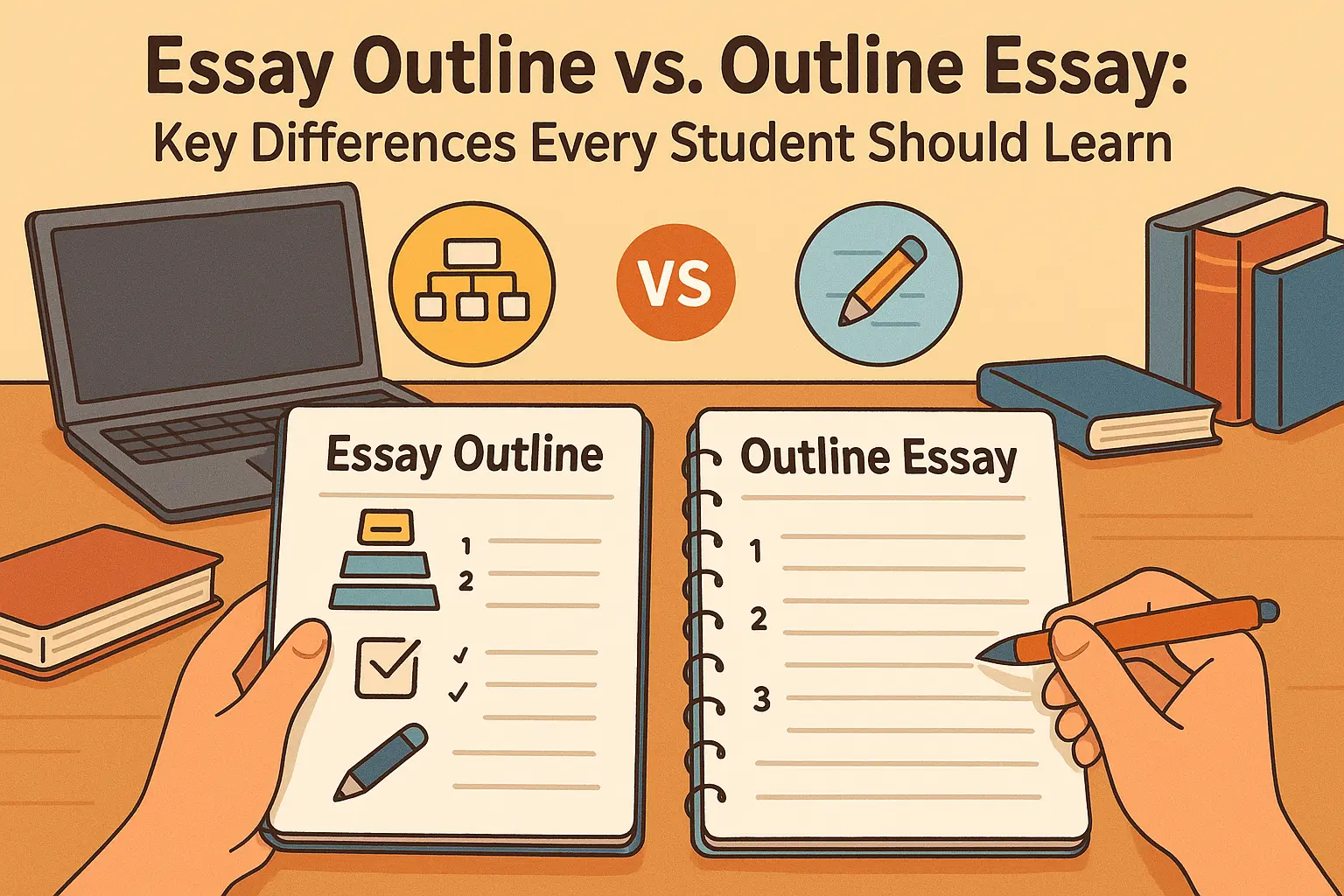
Essay Outline vs. Outline Essay

Essay Outline vs. Outline Essay: Key Differences Every Student Should Learn

Writing is a crucial component of a student’s academic journey. Whether you are working on a short assignment, a term paper, or a research project, writing well-structured essays is an important skill. However, many students often confuse two related but different terms: essay outline and outline essay. These two phrases may sound similar, but they have distinct meanings in the academic world.

In this blog, we will explore the key differences between an essay outline and an outline essay, explain why both are important, and provide tips on how students can use them effectively. By the end, you will not only understand the difference but also learn how these tools can make your writing process more organized, clear, and effective. If you ever feel lost while writing, you can also look for help to write an essay, but first, understanding the basics is very important.

What is an Essay Outline?

An essay outline is a structured plan that organizes the main points and supporting details of your essay before you actually start writing. Think of it as a blueprint for your essay. Just as architects use blueprints before constructing a building, students use outlines before writing essays.

Features of an Essay Outline:

  1. Organizational Tool – It presents the essay’s structure in a simplified form.
  2. Step-by-Step Guidance – Helps you know what to write in each paragraph.
  3. Clarity – Prevents repetition and keeps ideas focused.
  4. Flexibility – You can change or adjust your points easily before the actual writing.

Example of a Simple Essay Outline:

Topic: The Benefits of Reading Books

  1. Introduction
    • Hook: Begin with a quote about the joy of reading.
    • Background: Importance of reading in today’s digital age.
    • Thesis: Reading books enhances knowledge, fosters critical thinking, and promotes mental health.
  2. Body Paragraph 1: Knowledge
    • Books provide information and broaden perspectives.
    • Example: Reading history books helps students understand past events.
  3. Body Paragraph 2: Critical Thinking
    • Reading allows students to analyze arguments.
    • Example: Comparing different authors’ perspectives.
  4. Body Paragraph 3: Mental Health
    • Reading reduces stress and improves focus.
    • Example: People find comfort in fiction during stressful times.
  5. Conclusion
    • Restate thesis.
    • Encourage regular reading as a lifelong habit.

This is what we call an essay outline – it is a plan, not the whole essay itself.

What is an Outline Essay?

An outline essay is a type of essay that presents information in the form of an outline rather than in fully developed paragraphs. Instead of writing long sentences and detailed explanations, students write in point form or bullet points. It is less common in academic writing but can be used for quick presentations, summaries, or exam answers.

Features of an Outline Essay:

  1. Point Form Writing – Ideas are expressed as short points.
  2. Concise – Information is brief and to the point.
  3. Focus on Structure – It highlights the arrangement of ideas more than their explanation.
  4. Practical Use – Often used when time is limited or when only a summary is required.

Example of an Outline Essay:

Topic: The Benefits of Reading Books

  • Enhances knowledge: Provides information and widens perspectives.
  • Enhances critical thinking: Helps in analyzing and comparing ideas.
  • Supports mental health: Reduces stress, increases focus.
  • Conclusion: Reading is a powerful habit for lifelong growth.

This concise, point-based version serves as an outline essay. Although it does not delve into much detail, it organizes the main ideas clearly.

Essay Outline vs. Outline Essay: The Key Differences

Although the two may look similar, there are apparent differences:

Aspect

Essay Outline

Outline Essay

Definition A plan or framework for an essay. An essay written in outline form.
Purpose To guide writing before the essay is written. To present ideas quickly and briefly.
Detail Contains complete sentences and organized paragraphs (in plan form). Contains short points or phrases only.
Usage Used in the preparation stage. Used in writing itself, often in tests or summaries.
Length Longer, as it includes a thesis, topic sentences, and evidence. Shorter, because it only lists the main points.
Result Leads to a polished, complete essay. Produces a simplified version of an essay.


In short, the essay outline is a tool to prepare for writing, while the outline essay is a type of essay that is written in an outline format.

Why Understanding the Difference Matters

Students often face confusion because the terms are very close. However, mixing them up can cause problems in assignments and exams. For example:

  • If your teacher asks you to submit an essay outline, but you give them an essay outline, you may lose marks for misunderstanding the task.
  • If you only prepare an essay outline but never practice writing an outline essay, you may struggle in exams where you need to write answers quickly.

Therefore, learning the distinction between an essay outline and an outline essay is essential for academic success.

How to Write an Effective Essay Outline

Now that we understand the difference, let’s examine practical steps for crafting a strong essay outline.

Step 1: Understand the Assignment

Read the essay question carefully. Determine whether it is argumentative, descriptive, analytical, or narrative in nature.

Step 2: Brainstorm Ideas

Write down everything that comes to mind about the topic.

Step 3: Organize Ideas into Main Points

Group related ideas together under major headings.

Step 4: Create Subpoints

Add examples, evidence, or explanations under each main point.

Step 5: Review the Outline

Check if it flows logically and supports your thesis.

How to Write an Outline Essay

Writing an outline essay is different. Since it uses a point format, the focus is on clarity and brevity.

Tips for Writing an Outline Essay:

  1. Be Clear and Direct – Use simple words and avoid long sentences.
  2. Stick to Main Ideas – Avoid overloading with unnecessary details.
  3. Use Bullet Points or Numbers – Keep the structure easy to follow.
  4. Follow Logical Order – start with the introduction points, then the body, and conclude with a conclusion.

Common Mistakes Students Make

When dealing with an essay outline and an outline essay, students often make mistakes such as:

  1. Confusing the Two – Submitting an outline essay when the teacher asked for an essay outline.
  2. Too Much Detail in Outline Essay – Adding paragraphs instead of short points.
  3. Too Little Detail in Essay Outline – Forgetting to include topic sentences, thesis, or evidence.
  4. Skipping the Outline Stage – Writing essays without planning, which leads to a weak structure.
  5. Over-Reliance on Points – Some students think writing points is enough and avoid full essay writing.

Why Both Are Useful

Even though they are different, both tools are helpful for students:

  • An essay outline makes writing easier and faster.
  • An outline essay helps students practice summarizing and organizing ideas quickly.
  • Together, they improve a student’s ability to structure thoughts, present arguments, and manage time effectively.

If students still find the process confusing, they can always seek help writing an essay from teachers, peers, or professional writing guides.

Practical Example: Topic Comparison

Let us take one topic and show both versions side by side for better understanding.

Topic: The Role of the Internet in Education

Essay Outline:

  1. Introduction

    • Hook: Quote about the internet in modern learning.
    • Background: The Internet’s growing role in classrooms.
    • Thesis: The Internet enhances access to knowledge, improves engagement, and prepares students for future careers.
  2. Body Paragraph 1: Access to Knowledge

    • Online resources and e-libraries.
    • Example: Students in remote areas have access to quality materials.
  3. Body Paragraph 2: Engagement

    • Interactive tools, multimedia learning.
    • Example: Use of videos and simulations in science learning.
  4. Body Paragraph 3: Career Preparation

    • Digital skills for the workplace.
    • Example: Coding, online collaboration tools.
  5. Conclusion

    • Restate the thesis and summarize.
    • Encourage a balance of traditional and digital learning.

Outline Essay:

  • The Internet enhances access to information.
  • Improves student engagement through interactive tools.
  • Prepares students for digital careers.
  • Conclusion: The internet is essential, but it should complement traditional teaching.

How Teachers Use Both in Class

Teachers often ask students to prepare essay outlines before submitting the final essay. This allows the teacher to check whether the student’s ideas are clear and organized.

On the other hand, outline essays may be required in exams where time is limited. Teachers use them to test whether students can identify and organize the most important points quickly.

Benefits of Learning Both Approaches

  1. Improved Time Management – Outlines save time during the writing process.
  2. Clearer Thinking – Students learn to organize ideas logically.
  3. Better Grades – Well-structured essays are easier for teachers to grade positively.
  4. Practical Skills – In real-life situations, summaries and outlines are often required in professional settings and communication.

Conclusion 

While the terms essay outline and outline essay sound almost the same, their roles are quite different. The essay outline is a planning tool that helps students create a comprehensive essay, while the outline essay is a type of essay written in a point-form format. Understanding the difference between the two is very important for academic success.

Students who master both will not only write better essays but will also be able to summarize, present, and organize their ideas more effectively. And if writing still feels overwhelming, do not hesitate to seek help to write an essay from reliable sources. Mastering these skills today will benefit you not only in school but also in your future career.

How to Write an Appendix

Top 15 Benefits of Knowing How to Write an Appendix

Introduction

When students listen to the word “Appendix,” they often feel confused and speechless. Many get surprised about: What basically goes in the Appendix, and why it is so necessary? If you have come to know how to write an appendix, then you can write your essay, research paper, and reports much strongly and professionally. Rather than covering your main point with excessive data or explanation, an appendix lets you form additional material in a well-ordered and manageable way.

Whether you are writing your academic essay, a business report, or working on your thesis, getting an expert to write an appendix gives you countless benefits. In this blog, we will explore the top 15 benefits of knowing how to write an appendix, while also showing how to connect to practical conditions (like when students are seeking “write my essay for me “services)


  1. Makes Your Work Look More Professional

Adding an appendix gives your essay or report a neater and more professional style. It shows that you understand how to follow proper writing standards. Instead of forcing extra details into the main text, you can place them at the end in a separate section. This makes your work look well-organized and polished.

  1. Helps Keep the Main Part Short and Clear

An appendix is also useful for keeping your main writing short and easy to read. If you have extra things like long tables, detailed numbers, or interview transcripts, you don’t need to put them in the main essay. By moving them to the appendix, your main points stay focused, simple, and clear for the reader.

  1. Gives Proof Without Breaking the Flow

Sometimes, readers want to see proof for what you are saying. But if you put too much evidence directly in your essay, it can make the writing feel heavy and hard to follow. An appendix solves this problem. You can place all the extra proof, like charts or detailed notes, in the appendix so your main writing stays smooth and enjoyable to read.

  1. Makes Your Research More Trustworthy

Including an appendix also shows that your research is strong and honest. By adding things like raw data, sources, or extra calculations in the appendix, you let readers see the background of your work. This makes your writing look more reliable, which is very important in academic essays and reports.

  1. Makes Reading Easier

A good essay should be clear and easy to read while still giving full information. An appendix helps with this balance. Readers can enjoy the main essay without getting lost in too many details, but if they want to explore more, they can check the appendix. This makes your work friendlier and more flexible for the reader.

  1. Perfect Place for Visuals and Charts

Sometimes, graphs, diagrams, or charts are too big or detailed to fit smoothly into your main writing. By putting them in the appendix, you keep your essay neat and organized. Knowing how to use an appendix means you can include these visuals in a way that supports your ideas without distracting from your main points.

  1. Shows Honesty in Your Work

When you include extra materials like survey forms, interview notes, or detailed references, it proves that your work is open and complete. This reduces the chance of someone thinking you left out key information or used your sources unfairly.

  1. Helps Students Who Struggle with Essays

Many students search online for “essay for me” because they find formatting tasks like appendices confusing. By learning how to write an appendix yourself, you become more confident and independent. Even if you get outside help, you’ll know how to check if the work is done correctly.

  1. Works Across Different Writing Styles

APA, MLA, and Chicago styles all have their own appendix rules. Once you understand the basics of writing an appendix, it’s much easier to switch between these formats without making mistakes. This saves time and keeps your work accurate.

  1. Makes Complicated Data Easier

In subjects like science, business, or social studies, data can be overwhelming. By placing raw numbers, charts, or detailed explanations in the appendix, you keep the main essay simple while still giving interested readers all the details they may want.

  1. Let’s You Add More Without Breaking Word Limits

Most assignments have strict word counts. Since appendices usually don’t count toward the total, you can add important information without worrying about going over the limit. This helps you meet requirements while still presenting full work.

  1. Makes Teacher Feedback Easier

One of the best reasons to learn how to write an appendix is that it saves time when your teacher or professor gives you feedback. Imagine this: you have already finished your essay, but your teacher says, “Can you explain this point in more detail?” Instead of rewriting the entire essay, you can simply point to your appendix, where the extra details are stored.

For example, if your essay is about a survey you conducted, you don’t need to put all the survey questions and answers in the main body. Instead, you can put them in the appendix. That way, when your teacher wants to double-check your work, they can go straight to the appendix without disturbing the flow of your essay. This makes it easier for both you and your teacher—you don’t waste time rewriting, and your teacher gets clear answers quickly.

  1. Useful for Future Careers

Learning how to write an appendix is not just for school—it is also a skill that can help you in your career. Many professional fields such as business, healthcare, research, and technology use appendices in their reports. For instance, a business report might have charts and graphs in the appendix, while a healthcare report could include patient questionnaires or test results.

By practicing this skill as a student, you prepare yourself for professional work. When you enter a job, you will already know how to organize supporting information in a neat and professional way. Employers value clear, structured reports, and using an appendix shows that you are serious about presenting your work properly. It’s a small skill, but it can make a big difference in your career.

  1. Builds Your Writing Confidence

Many students worry about whether their essays look polished or professional enough. Learning how to write an appendix can boost your confidence because it makes your work look more complete. When you include supporting material in an appendix, your essay feels more advanced, as if it were written by someone who knows how to handle academic tasks.

For example, if you are writing a history essay and you include extra timelines, letters, or maps in the appendix, your paper immediately looks stronger. You know that even if someone questions your information, you already have the evidence ready in the appendix. This gives you confidence and reduces stress when submitting assignments. It also shows your teacher that you are willing to go the extra mile to produce quality work.

  1. Prepares You for Bigger Projects

Another important reason to understand how to write an appendix is that it prepares you for future academic work, such as these, dissertations, or large research projects. These advanced projects often require you to include a lot of extra material—such as interview transcripts, questionnaires, coding guides, and raw data. Putting all of that into the main text would make your work messy and hard to read. That’s why appendices are a must.

By practicing the use of appendices now, you build a habit that will help you later. When you start working on a big project, you won’t feel lost because you will already know how to organize information. Instead of worrying about where to put long data sets or technical notes, you’ll simply place them in the appendix. This will save time and make your project look professional, well-organized, and complete.


How to Write an Appendix: Key Steps?

Now that we’ve covered the benefits, here are the basic steps on how to write an appendix:

  1. Label Clearly – Use “Appendix A,” “Appendix B,” etc., for organization.
  2. Include a Title – Briefly describe what’s inside (e.g., “Survey Questionnaire”).
  3. Order Logically – Arrange information in the order it is mentioned in your essay.
  4. Maintain Formatting – Follow your citation style (APA, MLA, etc.).
  5. Keep It Relevant – Only add materials that support your essay.

By following these guidelines, you ensure your appendix is not just a random collection of documents but a professional, helpful part of your work.

Final Thoughts

Learning how to write an appendix might seem like a small detail, but it brings enormous benefits to students and professionals alike. It keeps your essay clean, boosts credibility, and ensures you meet academic standards without overwhelming readers.

For students who often search “write my essay for me,” mastering appendices can make essay writing less intimidating and more manageable. Whether you’re working on a short paper or a lengthy research project, knowing how to organize supporting materials in an appendix gives your work an edge.

If you start practicing this skill today, you’ll find yourself writing essays and reports that are not only well-researched but also professional and impactful. In the long run, it’s one of the smartest skills any writer can add to their toolbox.

controversial debate topics

100 Controversial Topics for Students — School & Classroom

School is not just a place to read books and give tests everyday. It is a place where mind wonders, ideas grow, opinions form, and students gain confidence to speak up. Controversial debate topics can help you write an essay, prepare for a debate, or ignite your mind to know about others opinions. We have curated a list of controversial topics to write about school, learning and student-life. It is loaded with thought-provoking and challenging questions to help you debate with other fellows and find out their thinking. Let’s get started!

100 CONTROVERSIAL DEBATE TOPICS 

Education Topics

  1. Are smartphones hindering the learning process of students in school?
  2. Does school uniform maintain discipline in the school?
  3. Does school homework help students in learning or increase the burden for students?
  4. Should schools grade the students based on their attendance?
  5. Should schools allow students to bring smartphones with them?
  6. Do monthly assessments affect mental health for students?
  7. Should students be allowed to post on social media about school?
  8. Are private schools better than public schools?
  9. Are private schools providing a better education system than public schools?
  10. Should second language classes be taught from elementary school to help students get better growth in the future?
  11. Do skill-based evaluations increase academic performance in students?
  12. Is project-based learning more effective than giving homework?
  13. Do monthly assessments prepare students to achieve better grades in the final?
  14. Do monthly assessments reduce students’ creativity and well-being?
  15. Should students be taught about having a positive mindset to handle academic pressure?

Technology Topics

  1. Are online social media platforms harmful for school students?
  2. Is Tiktok affecting students’ performance in school and the classroom?
  3. Should AI writing tools be allowed for students to finish their homework?
  4. Should limited screen time help students in their school life?
  5. Is online learning bringing better change in the school system?
  6. Is screen time on social media and games ruining students’ focus?
  7. Is Youtube an educational tool in a student’s life?
  8. Should computer skills be taught from early childhood?
  9. Are social media influencers replacing old and traditional role models of education for students?
  10. Is technology helping students to brainstorm creative ideas?
  11. Is AI replacing the human tutors?
  12. Should Ai tools be banned during exams?
  13. Is virtual reality technology making an impact on the classroom teaching method?
  14. Is online learning a beneficial teaching method?
  15. Should wearable tech gadgets be allowed during exams?

Teaching & Learning Topics

  1. Should students be allowed to evaluate their teachers?
  2. Should creativity be prioritized as equal to academic performance?
  3. Does group work provide better understanding and communication than individual assignments?
  4. Should schools teach financial literacy from high school to help students in the future?
  5. Should emotional intelligence be taught in school to avoid teenage depression?
  6. Has the memorization concept become old in learning methods?
  7. Should teachers get full perks and benefits as any other profession?
  8. Should online exams be more normalized in schools?
  9. Are digital tools for teaching in the classroom useful?
  10. Is group learning a better method?

Lifestyle & Identity Topics

  1. Is becoming a child influencer harmful to academics and mental health?
  2. Is social media providing more knowledge than textbooks?
  3. Should students be allowed to style themselves in schools?
  4. Should students be allowed to express political and social views in school?
  5. Is protesting in a peaceful manner taught in school?
  6. Should physical education help students focus on their studies?
  7. Should the concept of winning and losing be taught in school to help students in their personal lives?
  8. Is prom night affecting teenage school students negatively?
  9. Is societal pressure negatively affecting students and their academic lives?
  10. Should students be allowed to skip their physical education and arts classes?
  11. Is it ethical to provide identity-based scholarships to students?
  12. Is it ethical to disclose socioeconomic background for school support programs?
  13. Should schools be allowed to monitor after-school students’ lives?
  14. Should students use personality tests for better career options before going to university?
  15. Should students not be allowed to express political views to avoid conflicts?

Science & Ethics Controversial Debate Topics 

  1. Should artificial intelligence be taught to middle school students?
  2. Should the concept of evolution be taught from middle school?
  3. Is it ethical to use facial recognition in schools for safety purposes?
  4. Is it ethical to monitor students’ social media activity?
  5. Should students be taught about vaccines and disease prevention?
  6. Is it ethical for teachers to use artificial intelligence tools for grading?
  7. Should animal testing be banned for scientific research purposes?
  8. Should chemical toxin experiments be harmful for high school students?
  9. Is nuclear fusion safe for the future?
  10. Is it ethical to clone humans and extinct animals?
  11. Should scientists be allowed to do human cloning for medical research?
  12. Is it ethical to create synthetic chemicals and test on animals for medical purposes?
  13. Should the government keep control of life-extending technology?
  14. Is it ethical to use life-extending technologies for increasing life span?
  15. Is it ethically correct to experiment with DNA sequences?

Mental Health & Well-Being Controversial Debate Topics

  1. Should mental health sessions be prioritized in schools?
  2. Are homework and monthly assessments affecting the mental health of students?
  3. Should nature therapy be allowed once a week to relax a student’s mind?
  4. Is social media damaging students’ mental health and self-esteem?
  5. Is the social pressure of getting A grades damaging the mental health of students?
  6. Should mental health therapy sessions be free and accessible in schools?
  7. Should meditation be practiced daily in school?
  8. Do consecutive examinations increase stress in students?
  9. Should emotional intelligence be mandatory to teach alongside academics?
  10. Should bullying be completely banned and restricted from schools to avoid mental health issues in students?
  11. Is talking to AI chatbots affecting the mental health of students?
  12. Should colleges and universities provide mental health sessions before giving admissions?
  13. Is therapy becoming commercialized and reducing the actual effect on humans?
  14. Should therapy sessions be provided to students before exams to release pressure and exam stress?
  15. Do mental health issues increase in students due to academic pressure?

Environment Controversial Debate Topics

  1. Should fast fashion need to be limited to prevent environmental harm?
  2. Can fossil fuels be fully replaced by renewable energy to prevent climate change?
  3. Should plastic packaging be allowed anywhere on the planet to prevent environmental harm?
  4. Are electric vehicles helping the environment or increasing harm?
  5. Should meat tax policy omit carbon emission or reduce healthy eating in humans?
  6. Plastic packaging and industrial waste are actually the contributing factors of climate change?
  7. Should tourism to fragile ecosystems be limited to save the environment?
  8. Are biodegradable products saving the environment?
  9. Is mining rare earth metals for green technology safe and sustainable for the environment?
  10. Should planting trees be mandatory to prevent the greenhouse effect?
  11. Should bottled water be banned to reduce plastic waste?
  12. Should schools teach climate change to increase the chance of keeping the environment clean and green?
  13. Should animal testing be allowed and ethical for environmental factors?
  14. Is environmental protection prioritized for a country’s economic growth?
  15. Should environmental standards be mandatory to follow to save carbon footprints in a country?

Final Words

We are sure you have found your topic to start a debate with your fellows. We have gathered this information for our students to explore big ideas with confidence. Whether you want powerful debate topics or you want controversial topics to write about, we provide everything tailored to your needs. These topics will help you ignite your thinking, start meaningful conversations, and express your views in a respectful manner. We help students learn through our services, organize their thoughts, and share their voice where it matters. Choose us and find the best controversial issue topics for essay and start making an impact!

Descriptive Essay Ideas

100 Descriptive Essay Ideas for Creative Writing

If you want to write essays that grab instant attention and stay in the reader’s mind for a long time? Descriptive writing is your gateway to tell the world about real, vivid, unforgettable storytelling. Anyone can make their way in the world of writing by practicing it. Whether you are students finding ideas for essays or a teacher or a new writer aiming to sharpen creative skills. Finding the right topic can spark creativity, imagination, and transform ordinary words into powerful stories. In this creative blog, you will explore 100 descriptive essay ideas and writing topics that can help you craft essays that attract, inspire, and stand out. Let’s find out!

DESCRIPTIVE ESSAY EXPLAINED!

What do you know about a descriptive essay language? Creativity, imagination, or freestyle writing? Let us tell you as our cheap professional essay writers have written a good amount of descriptive essays for the students to help them in their academic journey.
A descriptive essay is a type of writing that  provides you a free space to paint a picture with words. It focuses on sensory details like sight, sound, smell, taste, and touch to tell or describe a person, place, object, or any experience.  The aim of descriptive essays is to involve the reader and make them feel emotions through detailed imagery.

100 DESCRIPTIVE ESSAY IDEAS


DESCRIPTIVE WRITING TOPICS ABOUT PLACES

  1. A library filled with books and creative ideas
  2. A cozy resort surrounded by scenic mountains
  3. You favorite childhood park that you still visit
  4. A museum full of history and culture
  5. A local cafe by the lake side
  6. Long walks from university gate to department class
  7. The ice cream parlour that you loved since the age of 5
  8. A daily walk to the park during spring season
  9. Love for the Christmas season: A Festival To remember
  10. A cozy corner in your home to watch rainfall
  11. A breathtaking hotel in the middle of the mountains
  12. A burger joint that reminds you of childhood memories
  13. A train station with thousands of stories
  14. A visit to Japan after your marriage
  15. A local cafe with cartoon characters


DESCRIPTIVE WRITING TOPICS ABOUT OBJECTS

  1. A beautiful vintage car on the show
  2. A handwritten letter that reminds you of good old days
  3. A childhood toy that stayed with you
  4. A favourite piece of jewelry from your mother
  5. A musical instrument in your home that gathers everyone together
  6. A diary of secrets
  7. A recipe book that made you a chef
  8. A wedding dress that you never forget
  9. You first childhood bike
  10. An old gaming console that you still have
  11. Flower petals in your diary that reminds you of old memories
  12. A favourite snack that brings back nostalgic memories
  13. A pen your got from your teacher
  14. The clothes of your childhood that your mother have
  15. The musical instrument you got on your 15th birthday


DESCRIPTIVE WRITING TOPICS ABOUT EVENTS

  1. A surprise birthday party
  2. My first trip to Japan
  3. First day at school
  4. A food festival full of new eateries
  5. A destination wedding ceremony
  6. Family gathering at the beach house
  7. Summer break at grandma house
  8. A sports match at MCG stadium
  9. A road trip adventure
  10. A concert under the stars and moonlight
  11. Your first date as a teenager
  12. A trip to disneyland as a kid
  13. A farewell party at your office
  14. A wedding proposal on the cruise ship in the middle of the ocean
  15. A charity event that changed your life for good

DESCRIPTIVE WRITING TOPICS ABOUT EMOTION & EXPERIENCES

  1. The excitement of getting first bike
  2. The fear of giving presentation
  3. The feeling of falling in love
  4. The joy of watching your child grow
  5. The pain of losing your loved ones
  6. The anxiety before giving an exam
  7. The thrill of winning your first match
  8. The peace of listening to your new born’s voice
  9. The excitement of getting promotion
  10. The sadness of saying goodbye to your loved ones
  11. The calm and serenity of watching a rainfall
  12. The comfort of a hug from your loved ones
  13. The excitement of reuniting with your loved ones
  14. The tension and frustration after having a fight
  15. The thrill of overcoming your fears

DESCRIPTIVE WRITING TOPICS ABOUT TRAVEL & CULTURE

  1. A foodstreet in Asia
  2. Sky diving experience in Dubai
  3. A cruise experience
  4. A train adventure in New Zealand
  5. A temple in Phillipines
  6. A traditional Indian wedding ceremony
  7. Food tasting tour in Pakistan
  8. A walk to remember under the sakura
  9. An ancient castle in Scotland
  10. A desert safari experience in the UAE
  11. Seven wonders of the world
  12. A journey to the Moon and back
  13. A historical trip to Colosseum
  14. A visit to Buckingham Palace
  15. A thrilling expedition to Himalayas

DESCRIPTIVE WRITING TOPICS ABOUT NATURE

  1. Foggy morning in the Winters
  2. A snow-covered mountains
  3. A sunset at the beach
  4. A blooming cherry blossoms in the spring
  5. Leafy roads in the Autumn
  6. A glimpse of rainbow after the rain
  7. Beautiful fairy meadows before the mountain
  8. A blizzard in the city
  9. A walk by the bioluminescent beach
  10. The northern lights in Arctic region
  11. A trip to African forests
  12. The smell of pine trees in winter forest
  13. Snow flakes on Christmas eves
  14. The beauty of exploring marine life under the ocean
  15. The golden hour over the mountains

DESCRIPTIVE WRITING TOPICS ABOUT PROFESSIONS

  1. Your first concert of your favourite singer
  2. Doctors that reminds you of cure and treatment
  3. Your childhood dream to become an aircraft pilot
  4. One day as the President of your country
  5. What is it like to be a Hollywood star?
  6. Struggles of becoming an Olympic champion
  7. Never ending work of an army officer                                                                                                                                
  8. Fear of working as a police officer
  9. Struggles of dealing with a psychiatrist
  10. Happiness of becoming an airforce pilot one day


FINAL THOUGHTS

Descriptive essays are a fun way to make your writing creative but you also need to understand the topic, situation and then play your part by writing. These are not just assignments but an opportunity to explore creative thinking, express emotions, and a good way to connect with your readers. Always remember to deliver your words that they feel like real, whether writing about a person, place, or any experience.
We are sure that you have just found your topic to start writing on. Our 100 descriptive essay examples will help you in the long run of becoming a writer, blogger, or writing your assignment. If you ever need crafting your essay or not figuring out where to start then our affordable essay writing services are here to help. Designed to help you craft an original, creative and perfect essay in no time. Moreover, you don’t need to worry about the budget as our team of cheap essay writers online, you will get the personalized support tailored to your requirements. Affordable Writing is all about keeping our students satisfied without letting them break the bank!

how to write a dbq

How to Write a DBQ: Beginner to Advanced Strategy Guide

Are you someone preparing for an AP history exam or working on some assignment, and you are stuck with the DBQ? Well, you are not alone in this! DBQs are tricky yet tiring to write, especially when you have a bunch of documents to start with. You can write a great DBQ if you have the right approach, and to have the right approach, you need to have the right mindset and strategic guidance.
In this blog, we are going to share everything to help you write a DBQ, from beginner to advanced. From beginner tips to advanced strategies, our expert assignment writers have gathered all the information to help you write clear and effective essays that stand out. Let’s get started!

DBQ EXPLAINED!

A Document-Based Question (DBQ) is an essay where you will be asked to answer the question from the historical documents provided to you. DBQs are usually a part of AP history exams, including US, World, or European history. DBQs are not like traditional essays; they provide you with 5-7 documents, which include letters, maps, speeches, charts, etc., that you have to include in your response. DBQs are essays that test your ability and help you to:

  • Understand history and its context
  • Build a strong thesis by doing extensive research
  • Write a logical yet persuasive essay
  • Use the evidence effectively in the right place.

DBQ GUIDE FOR BEGINNERS

  1. Analyze the Prompt Carefully

Take your time and read the prompt carefully before checking the documents. Analyze:

  • What is the main question in this prompt?
  • What is the theme?
  • What issues are raised?
  • What is the time period of the question?

Bonus: You can use keywords like “causes, compare, effects, or evaluate” to make your essay strong.

  1. Skim the Documents Strategically

Read the documents and find out the main points that help you write an effective essay:

  • Look for author and date
  • Search for author’s point of view
  • What is the main idea of the prompt?
  • How does it connect to the prompt?
  1. Categorize Your Documents

Read the documents carefully and organize them into 2-3 categories for your ease. In this way, you can strengthen your essay and make your argument more clear to write an essay.

Example: If the DBQ is about building towns for underprivileged people, group documents into:

  • Economic Issues
  • Political Involvement
  • Social divisions
  1. Research Makes A Strong Thesis Statement

Use your time and do extensive research to make a strong thesis. It should include:

  • A comprehensive answer to the promptDirectly answer the prompt
  • Include your argument
  • Your categories that creates sound and clear meaning

DBQ ESSAY GUIDE : INTERMEDIATE TIPS

  • Make An Introduction Paragraph
  • Start with a hook to grab the reader’s attention. It could be a quote or a surprising fact.
  • Provide a brief historical context to ignite the interest
  • Conclude with your thesis statement to sum-up the whole essay
  • Body Paragraphs (2–3)
    Each paragraph includes:
  • One category or theme
  • Present 2-3 documents as evidence
  • Do research and present outside knowledge which is not present in the documents
  • Analyze the documents properly, don’t just summarize
  • Must-Have: POV And Contextualization

If you want to score high, the dbq essay format includes these:

  • Point of View (POV): What factors could influence the author’s opinion?
  • Contextualization: What kind of historical events happened that time to set this topic?

Advanced DBQ Essay Strategies For Experts

Amalgamation

Blend your argument to a different time period, region, or theme to help understand the answer.

Use Complex Reasoning

Move past from the cause and effect theory. Teel about how different factors worked together and how the issues changed over time.

Explain The Visuals Given In Your DBQ

If the visuals like maps or charts are given in your DBQ, try to:

  • Provide a brief description of the visuals
  • Explain the relevance
  • Connect them to your argument

AVOID THESE MISTAKES WHEN YOU WRITE A DBQ ESSAY

  • Don’t summarize the documents without analysis
  • Not using outside knowledge will weaken the argument
  • Writing an ambiguous thesis and not providing clarity
  • Not grouping the documents
  • Forgetting about writing a POV or contextualization

FINAL TIPS ON HOW TO WRITE A DBQ ESSAY

  • Breakdown The DBQ Prompt Step By Step
    Before starting your DBQ essay, you have to read the prompt carefully and understand the question. To make it easy, paraphrase it in your own words to understand.
  • Clear Your Mind Before Writing
    You can use outlines and charts to group your documents by theme.You can match them with your thesis as this will help you save time during writing.
  • Practice Document Analysis And Save Time
    Make a routine of reading one primary source a day. Try to identify the author’s purpose, audience, tone, and bias. This will help you in analyzing the document quickly.
  • Make Stronger Thesis With Feedback
    Practice writing a thesis before the actual time and get the feedback from your teachers, friends, and family. This will help you shape your thesis into a stronger essay.
  • Time Management Techniques To Finish Your Essay In Time
    Use your time strategically. Divide your time; 5 minutes for your planning, 25 minutes for writing, and 5 minutes for re checking. This will help you from last minute pressure.
  • Use Real and Past Exam Prompts to Achieve Success
    Find the past and real DBQ questions to do your practice from them. Thai will help you in understanding the format and how to do it successfully within time.

FINAL THOUGHTS

By carefully following this guide, writing a DBQ doesn’t need to feel pressured or confusing. If you know the right techniques and a solid trick to take each step effectively, then you can bypass all the pressure of historical documents. You can analyze them and turn them into a persuasive yet high-scoring essay. Whether you’re a beginner still learning the basics or someone keeping an eye on the perfect score, this guide has given you the strategies to succeed, from how to write a dbq essay to all dbq examples, and dbq format. This blog has covered everything!

So next time you’re stuck with a DBQ, take a deep breath and remember: you’ve got this blog, and you have got the skills, the strategy, and the mindset to write an outstanding DBQ essay successfully. If you ever need extra support or assignment writing help, then you know where to find us. Affordable Writing is your go-to partner for all kinds of academic help, from Argumentative Essay Topics and assignment writing to exam assistance. Our assignment writers are available round-the-clock to help you succeed. Now, get your documents, outline your ideas, and start writing because we have got you covered!

How to Write High-Scoring Essays in AP Literature and Composition

How to Write High-Scoring Essays for AP Literature and Composition Students

Writing a high-scoring essay means having a strong grasp of writing, and strong writing is your way to succeed on the AP literature exam. You need to understand the literature and show the ability to explain ideas. A high-scoring essay means you should be able to break down the matter, pick out what’s important, and build a meaningful argument around it.
In AP Literature and Composition, the essay section is important and can feel quite pressuring. It demands strict time limits, prompts, and advanced analysis. It’s not all about being a literary genius; it’s about having a clear strategy, a powerful voice, and an analytical mindset to present your essay effectively.

You can master the art of writing high-scoring essays by following our guide carefully. We will walk you through everything you require to write high-scoring essays in AP English literature and composition. Essays that impress your teachers, spark curiosity, and reflect your critical thinking skills.

THE EXAM EXPLAINED!


The AP Literature and Composition exam consists of three kinds of essays. Learning the concept will help you prepare better and deliver the best in your exam.

1. Poetry Analysis

In this section, you will be provided a poem that you have to read and will be unknown to you. After reading, you will have to write an essay explaining about the poem, what it is saying, and how the poet uses the language and tone to express emotions or ideas in it.

THINGS TO FOCUS ON:

  • Read the entire poem carefully and identify the tone—how the poet feels.
  • Notice the elements of literature—is the poet using metaphor to explain the concept, imagery, or symbolism?
  • Identify the way of writing or the poem’s structure—is the post described in short lines, using punctuation, or using an unusual formatting? Every little detail could be meaningful.
  • Think about the theme of the poem—paying attention to details tells you about the story. Is it about life, human nature, or fiction?

2. Prose Fiction Analysis

In this section, you will be given a short passage to read from a story or a novel. You need to analyze how the author tells the story.

THINGS TO FOCUS ON:

  • Pay attention to the characters of the story—what message is the author giving?
  • Look at what kind of language the author uses—suspense, emotion, fun, or tension.
  • Observe the point of view about the story. What revolves around the story, and what did you learn?
  • Observe how dialogues and actions are delivered, which tell the deeper meaning of the story.

3. Literary Argument

In this section, you will be provided a question, and you will be free to choose any literary work of your choice and support the argument in your way. This will be your chance to show your strongest knowledge to help you shine.

THINGS TO FOCUS ON:

  • Read the question carefully and pick your novel, play, or story to proceed further.
  • Do your research, choose wisely, and create a strong thesis to create a meaningful argument.
  • You can use the specific examples from the book you choose to support your ideas.
  • Put your focus on how and why to present your ideas strongly.

HOW THE TEACHERS WILL GRADE YOU?

The grading system in AP english literature and composition is based on three main things and those are:

  • Clarity of your answers or how you present your thesis. This shows your understanding of the questions asked.
  • Providing good examples in your answers like using quotes. Also providing the explanation of the quote matters, don’t just copy paste the line.
  • Writing an essay with a strong writing style and voice. You should sound confident, organized, and deliver a clear answer about the topic.

Bonus: Try to show originality by using simple words. Don’t go for jargon or old-fashioned. Write like you know exactly what it wants. This will help you succeed.

STRATEGY TO WRITE THE BEST ESSAY

Follow the tried and tested method to write your essay in the best structure:

  1. Read Actively And Carefully

Don’t just skim; read the passage carefully to make the structure. Try these:

  • Use literary devices like metaphors, alliteration, and symbolism to make your essay noticeable.
  • Make shifts in tone and perspective to keep the reader engaged.
  • Observe what the author is saying about human nature and experience.
  1. Craft a Focused Thesis

Do your research and make a strong thesis:

  • Be specific, use a clear tone.
  • Use argumentative matter that connects and creates curiosity.
  1. Make An Outline Before You Write

Try to create an outline to help you understand the structure of your essay.
A quick blueprint keeps your essay on track:

  • Introduction includes your hook to grab the reader’s attention.
  • Body matter includes paragraphs with a main idea in each supported by evidence.
  • Write an insightful conclusion to give a powerful ending for readers to remember.
  1. Provide The Evidence That Works

Let your text speak for itself. Don’t just put quotes like quotes; make it work for you. Treat each quote like a conversation starter and explain how it connects to your point and what the purpose of using the quote is. Choose the quotes that deliver your claim with precision.

  1. Provide Smart Analysis That Stand Out

Develop a commentary that helps you shine. Use the matter and explain why it matters and what the purpose is. Observe how the author uses the literary tools like tone, imagery, symbolism, or structure to build meaning in the text. Use your words to express identity, struggle, or nature. This will be your chance to gain the attention of your teacher.

USE SIMPLE WORDS TO PRESENT STRONG IDEAS

To present a good writing style, you don’t have to use fancy words, but try to express your ideas in a simple and clear way. Use short-length sentences to keep the readers engaged. It keeps your style strong and natural. Use words that impact the voice of your essay, like “reveals,” “shows,” or “emphasizes.” These kinds of words help you make your point clear, whereas using “stuff,” “a lot,” and “kind of” complicates the message. In the last, be confident enough to write with clarity even if it means using a simple language—because simple words tell the story and help you succeed.

PRACTICE IS THE KEY TO AP LITERATURE AND COMPOSITION SUCCESS

If you want to write a high-scoring essay in AP literature and composition, then you better practice aggressively to succeed in first place. Everything requires practice to become the master of it. 

  • Set a time limit to write a full essay with focus and speed.
  • Take help from past AP English literature and composition prompts and sample papers to identify what works and what’s a must-have to prepare.
  • Friends, family, and your mentors are the honest supporters and provide you the actual feedback to help you improve.

Bonus: You can take help from College Board’s released exams to study real prompts and check out how essays are scored.

MISTAKES THAT EVERY STUDENT MAKE

If you want to avoid losing points on your essay, then keep reading and don’t make these mistakes:

  • Whatever happens, don’t skip the hook and thesis. Use clear words to prove your point and help the teacher understand your purpose.
  • Don’t use repetitive words to blur the story; use the words to mean it.
  • Use your quotes wisely—write like you mean it.
  • Always answer your main question in the prompt. It will help you score high.

Keep your writing steer clear of these mistakes because they can hurt your score. Stay focused, use a clear voice, and let your strong ideas do wonders for you. Moreover, you can always reach our assignment writers to get all the help you want to succeed in your exam.

CONCLUSION

Writing high-scoring essays in AP Literature and composition brings you great scores and better opportunities. It helps you grow as a thinker and better communicator. To express your ideas clearly, analyzing your text deeply, and building strong arguments are some of the great skills that take you through your college, career, and everyday life. At Affordable Writing, we are always ready to welcome you with any kind of exam help, whether AP Literature, online assignment, or essay writing. We provide affordable essay writing services to help you ace any problems that come your way. So, whether you are using a Sylvia Plath poem or analyzing the tense mood in The Great Gatsby, our cheap writing services have all the voice, insight, and tools to help you craft a high-scoring essay successfully.

How-to-Write-an-Essay-Example-for-Student's

How to Write an Essay Example for Students?

How-to-Write-an-Essay-Example-for-Student's

How to Write an Essay Example for Students?

Whether you are in a high school or a college, writing an exam has always been an essential skill for students. Many students bear a lot of issues while writing an essay and they are struggling with structuring their essays properly. However, if you are one of them then don’t worry, this blog will give you with the information and help creating a great Essay Example that is clear, well-organized, and engaging. It will also provide guidance about how to find affordable assignment writing service if you need a little extra help.

UNDERSTANDING THE BASICS OF AN ESSAY EXAMPLE

it’s always important to understand what an Essay Example is before jumping into the writing. Simply put an Essay Example with proper formatting, structure, and content will serve as a model or sample essay. It will help students to gather different writing methods or techniques and can improve their writing skills.

Step-wise Guide to Writing an Essay Example

For a student or any professional person writing an essay can be overwhelming thing but breaking it into steps can make the process easier. So the following structure can help you ensure clarity and coherence.

Step 1: Grasp the Essay Theme and Expectations


Before you even start writing, you should know the essay instructions or prompt. Reflect on

  • What is the main topic or question?
  • What category of essay is required (argumentative, descriptive, narrative, etc.)?
  • What are the formatting requirements and word limit?
  • Are there any specific sources or guidelines to follow?
  • Taking time to examine the question makes sure that you stay focused and meet the essay’s objectives.

Step 2: Choose a Strong Topic

While crafting an effective Essay Example is selecting a captivating topic. Choose your topic with full freedom and go for something interesting. A strong topic keeps your readers engaged and makes your essay more enjoyable to write.

  • Try to select one that is:
  • Fascinating and pleasant
  • Pertinent to your field of study
  • Specific and attentive (avoid overly extensive topics)

A well-chosen and strong topic makes the writing process smoother, keeps your reader engaged and makes your essay more enjoyable to write

Example:

  • Too Broad: Climate Change and Its Effects
  • Better: The Impact of Industrial Pollution on Global Warming

Step 3: Conduct Thorough Research

Good research is the foundation of any well-written Essay Example and is backed by strong evidence. Use trustworthy sources like:

  • Books
  • Academic journals
  • Government and university websites
  • News articles (from reliable sources)

Tips for effective research:

  • Take notes while reading
  • Organize your findings into categories
  • Use reliable citation tools to track sources

Conducting in-depth research helps you provide strong arguments and factual information in your Essay Example. Always cross-check sources to ensure accuracy and avoid misinformation.

Step 4: Create an Outline

Before writing your Essay Example, create an outline. An outline helps structure your essay logically prevents writer’s block and organizes their thoughts. It also allows you to logically connect different sections, ensuring a smooth transition between ideas. Your outline should include:

Introduction

  • Hook (an engaging opening sentence)
  • Background information
  • Thesis statement (your main argument)

Body Paragraphs (3-5 paragraphs)

Each paragraph should focus on one main idea, supported by evidence and examples. Use the PEEL method for clarity:

  • Point: State your main idea
  • Evidence: Provide supporting facts, statistics, or examples
  • Explanation: Explain how the evidence supports your argument
  • Link: Connect the paragraph to your thesis or the next idea

Conclusion

  • Summarize key points
  • Restate the thesis in a fresh way
  • Provide a final thought or call to action

Step 5: Write an Engaging Introduction

Foe setting the tone for your essay write an engaging introduction. It provides a glimpse of what to expect and also capture the reader’s attention and provide some background on the topic. 

How to write a strong introduction:?

  • Start with a hook (a question, quote, or interesting fact)
  • Provide context for your topic
  • Conclude with a definite closing statement that emphasizes the primary argument of your essay 

Example:

Known as industrial pollution, carbon emissions have from over the years grown significantly, causing great environmental harm. Registered as 20% of global warming, industrial pollution is reverse. The essay will discuss how industrial pollution helps to cause climate change and possible solutions to reduce its effects.

Step 6: Develop Clear and Strong Body Paragraphs

Each body paragraph in your Essay Example should concentrate on one argument and provide evidence to support it.

Key elements of a body paragraph:

  • Topic Sentence: Introduces the main point
  •  Evidence & Examples: Facts, quotes, statistics, or case studies
  • Explanation: Analyze the evidence and connect it to your thesis
  • Transition Sentence: Ensure smooth flow between paragraphs

To make your Essay Example more captivating, use real-life examples, statistics, or expert opinions to reinforce your points.

Example Body Paragraph:

Copyright industrial pollution, discharged greenhouse gases will help to warm the planet severely. Factories release yearly more than two billion metric tons of CO2, says an EPA study. The increase in carbon emissions captures heat in the atmosphere, raising worldwide temperatures. Therefore, it is absolutely pertinent to slowing climate change to introduce more stringent rules on industrial emissions.

Step 7: Write a Strong Conclusion

Your conclusion should include all the key points discussed in your Essay Example and ingeminate your work in a new way.

How to write a compelling conclusion:

  • Summarize the main arguments
  • Restate the thesis in a fresh way
  • Offer final understandings, course of action, or encouragement

An impressive conclusion leaves a long lasting impression and highlights the message of your essay.

Example:

Finally, industrial pollution still a prominent cause of global warming. Stricter environmental regulations and promotion of sustainable methods would help us to lower carbon emissions and preserve our world. “to guarantee a more favorable environment for next generations, instant action is needed.

Step 8: Revise and Edit

Once you’ve written your Essay Example, take the time to review it. Never submit your first draft! Editing is key to producing a polished essay.

Checklist for editing your essay:

  • Check for grammatical and spelling errors
  • Ensure clarity and logical flow
  • Verify citations and references
  • Remove redundant or unclear sentences
  • Read your essay loudly to spot awkward phrasing

Step 9: Format and Cite Sources Correctly

According to your assignment requirement, you may need to format your essay in APA, MLA, or Harvard style.

Common citation mistakes to avoid:

  • Forgetting to cite sources
  • Using unreliable references
  • Incorrect formatting 

Step 10: Submit Your Essay

Once you’re done with your essay, then it’s time for submission. If feasible, seek a help from peer for final feedback before submitting.

Mistakes to Avoid in an Essay Example

Many students make common mistakes that enervate their essays. Here are some mistakes explained:

  • Lack of structure: Clear structure is essential without it your Essay Example can become confusing.
  • Weak thesis statement: An indeterminate or broad thesis weakens your argument.
  • Spelling and Grammatical errors: Check your work thoroughly to remove errors.
  • Citing problems: Plagiarism can create problem, so always give credit to your sources.
  • Repeated sentences: Avoid repetition by presenting fresh ideas in every

paragraph.

  • Weak transitions: Ensure smooth transitions between sections for better readability.

Tips for Writing a High-Quality Essay Example

  • Start timely to stay away from last-minute stress
  • Follow the structure (Introduction, Body, Conclusion)
  • Use clear and concise language
  • Stay on topic and avoid unnecessary details
  • Support your arguments with credible evidence
  • Edit and proofread before submitting
  • Use active voice instead of passive voice for a more attractive read
  • Break long paragraphs into shorter ones for better readability

How to Find Affordable Essay Writing Services?

Some students often find difficulty in writing an essay, so they can find help online like affordable essay writing. These are professional helps in reasonable prices.

Consider the following points while choosing an affordable essay writing service

  • Analyze customer testimonials.
  • Examine for plagiarism-free guarantees.
  • Ensure they offer revisions and refunds.
  • Look for experienced writers in your field.
  • Ensure the service meets deadlines efficiently.

Benefits of Using an Essay Example

Using an Essay Example offers several advantages:

  • Provides a clear structure
  • Improves writing skills
  • Boosts confidence (A good Essay Example can serve as a guide, making the writing process easier and less intimidating).
  • Enhances research abilities
  • Saves time

Conclusion

Writing an Essay Example does not have to be a difficult task. Following the instructions given will help you to generate an essay that is well ordered, engaging, and informational. Don’t be afraid to seek extra assistance from affordable essay writing services if you are struggling. Whether you write it yourself or seek some help, mastery of essay writing will help you all along your education. Recall too that practice makes a perfect man, thus continue honing your abilities and learning from excellent Essay Example materials.

NARRATIVE ESSAY WRITING

How to write an Outline for Narrative Essay

Essays come in various shapes and sizes, each with its own unique approach to essay writing. The narrative essay, for instance, distinguishes itself from argumentative essays in terms of structure, tone, and diction. A narrative essay is a type of composition where the writer recounts a tale by connecting it to a particular predicament or problem. Unlike works of fiction, the story in a narrative essay is typically based on the author’s personal growth or development. Furthermore, this particular essay form permits the use of first-person pronouns, setting it apart from other forms of academic essay writing . In addition, narrative essays can be associated with personal anecdotes or experiences, allowing the writer to express their perspective and insights in a powerful and relatable manner.

Storytelling Vs. Narrative Essay

When it comes to the narrative essay, the act of narrating a story is distinct from simply telling one. Unlike storytelling, where the author has the liberty to alter the tale, including changing its plot, the narrative essay must remain faithful to actual events to weave a coherent narrative thread. In contrast to a story, a narrative essay has a thesis statement, which serves as the foundation for the author’s argument or perspective. Additionally, like any other form of essay, a narrative essay requires an outline to provide structure and guide the essay writing process. Fortunately, crafting an outline for a narrative essay is a straightforward process, and the following steps can be used as a guide:

Introduction of a narrative essay is a crucial element

Narrative Essay

The introduction of a narrative essay is a crucial element that sets the stage for the reader. It typically consists of three essential components: a hook, a statement about the importance of the narrative, and a thesis statement. The hook is an attention-grabbing opening sentence that captivates the reader’s interest and entices them to read further. It could be a startling fact, a thought-provoking question, a vivid description, or a poignant quote that relates to the narrative’s theme. The next part of the introduction focuses on the significance of the story being told. This part explains why the story is essential and why the reader should care about it. It could highlight the story’s universal themes, personal relevance, or broader societal implications. Finally, the introduction culminates in a thesis statement, which is the core argument or main point of the essay. This statement sets the direction for the narrative and guides the author in developing the essay’s content in a logical and cohesive manner.

Hook:

The storytelling can be presented in either first-person or third-person perspective, but it must begin with a compelling introduction such as a powerful statement, a quotation, or a noteworthy piece of information that serves as a hook to capture the reader’s attention.

Scope:

After the hook, it is necessary to provide an explanation of the topic’s relevance or significance, and the essay should establish a connection with the readers.

Thesis:

The thesis statement comes after defining the scope. It enables the writer to guide the readers towards a particular direction.

In summary, an essay ought to be concise, accurate, captivating, and relatable to the audience. It should seize the reader’s attention and stimulate their interest to read further.

Body Paragraph

1-Setting and Background

It is imperative that readers possess an understanding of the background or the underlying factors that led to certain events or circumstances. This knowledge can provide context, enhance comprehension, and allow the reader to develop a deeper appreciation of the subject matter.

2-Character Description

Character Description in narrative essay

Developing multi-dimensional characters that experience growth and evolution throughout the narrative is crucial for an effective story. It enables readers to connect with the characters and understand their role in conveying important themes and messages.

3-Foreshadowing

The writer should include their own viewpoint or interpretation of the event being narrated. This can offer a unique perspective and add depth to the story. The writer’s personal insights and reflections can also provide the reader with a greater understanding of the author’s stance and their motivations for presenting the story in a particular way.

4-Event Description/ Conflict

It is essential that each paragraph provides a detailed description and analysis of the situation and the setting in which the story unfolds. This can enhance the reader’s understanding of the events, characters, and themes, and create a more vivid and immersive experience. The writer should aim to create a clear and cohesive narrative that effectively conveys the story’s message and captures the reader’s imagination.

5-Climax and Resolution

Narrative Essay Writing

The story should build up to a significant and dramatic turning point, known as the climax, which determines the ultimate outcome of the event. The climax could lead to a satisfying resolution or an unfortunate conclusion, depending on the nature of the story. This critical juncture should be carefully crafted to create a powerful impact on the reader and leave a lasting impression. The resolution should be meaningful and provide closure to the narrative, tying up loose ends and satisfying the reader’s expectations.

Conclusion

The conclusion must have the following components

1-Moral Significance

2-Ethical Significance

3-Character Development

4-Call For Action

It is important for the story’s conclusion to convey a moral message or lesson that the reader can take away from the narrative. The ending should serve as a reflection on the events that transpired throughout the story and the characters’ development. It should also provide a sense of closure and resolution to any conflicts or issues presented within the narrative. Additionally, the ending should offer an ethical perspective that highlights the importance of taking action in response to the events portrayed in the story. This can encourage the reader to reflect on their own beliefs and values and inspire them to make positive changes in their own lives.

Now affordablewriting.net also offers Online Class Help and Online Home Work Help because our clients need it.

Also find our informative blogs on Blogspot.com

Persuasive Essay

How to write an Outline for Persuasive Essay

A persuasive essay writing is a form of academic writing that seeks to influence and persuade the reader to adopt the author’s point of view on a given topic. In order to write a successful persuasive essay, the author must possess a deep understanding of the subject matter at hand. This necessitates conducting thorough research and collecting reliable and relevant sources of information to support the author’s arguments. Additionally, the writer must critically examine their own biases and be transparent about their perspective to build credibility and establish trust with the reader. The primary objective of a persuasive essay is to persuade the reader to agree with the author’s point of view by presenting well-reasoned arguments, clear evidence, and logical reasoning. The success of a persuasive essay can be measured by the extent to which the reader is convinced that the author’s perspective is the most valid and credible interpretation of the subject matter, leaving no room for alternative points of view. Ultimately, a well-crafted persuasive essay can be a powerful tool for shaping and influencing public opinion, and can have a profound impact on society as a whole.

Persuasive Essay vs. Argumentative Essay

Outline for Persuasive Essay

It is important to distinguish between the persuasive essay and the argumentative essay before delving into the outline for persuasive essay. While both types of essays aim to convince the reader, they differ in their approach and purpose. An argumentative essay relies on data and logical reasoning to support a specific argument, often using a compare and contrast or argument and counter-argument structure. On the other hand, a persuasive essay employs research to develop a coherent point of view that persuades the reader. The purpose of a persuasive essay is to convince the reader of a particular viewpoint, while an argumentative essay is more focused on presenting and defending a specific argument. In a persuasive essay, the author must demonstrate a deep understanding of the subject matter, present compelling evidence, and use effective rhetoric to appeal to the reader’s emotions and values. Ultimately, the goal of a persuasive essay is to inspire action or change in the reader’s beliefs or behavior, making it a powerful tool for social and political advocacy. By crafting a well-constructed persuasive essay, the author can engage readers and shape public opinion on important issues, contributing to positive change in society.

Outline for Persuasive Essay

The general outline comprises of

1-Introduction

2-Body Paragraphs

3-Conclusion

To enhance organization, it is possible to break down the content into headings and sub-headings. Creating an outline is important since it helps ensure that the writer stays focused.

The following is a comprehensive summary of the outlined details.

1-Introduction

Essay Writing

When writing a persuasive essay, the introduction serves as the foundation upon which the author lays out their argumentative stance. To achieve this, the author typically employs a comprehensive set of statements that are intended to capture the reader’s attention and impart upon them the author’s subjective perspective. The introduction consists of three essential elements that work in tandem to effectively convey the author’s argument. Firstly, the author utilizes a hook, which is a literary device designed to pique the reader’s curiosity and compel them to continue reading. Secondly, the author defines their audience, thereby ensuring that their argument is tailored to the reader’s interests and beliefs. Lastly, the author presents their thesis statement, which is a concise summary of the main argument that the essay will seek to substantiate. In combination, these three elements provide the reader with a comprehensive understanding of the author’s position, making a persuasive essay a powerful tool for convincing others of one’s viewpoint.

Hook

The opening statement of a piece of writing, known as the hook, is designed to capture the reader’s attention. This could be achieved by incorporating a captivating story, an intriguing piece of information, or a quotation.

Defining the Audience

persuasive essay

The beginning of a text should aim to establish a connection with the intended audience. The reader should feel engaged with the topic being discussed. It’s important to clearly define the boundaries and focus of the subject matter.

Thesis Statement

A thesis statement is a detailed declaration that outlines the intention or objective of an essay.

2-Body Paragraphs

In this section, the quantity of paragraphs needed is not predetermined but instead determined by the amount of arguments and claims an author possesses to substantiate their viewpoint. The structure of each paragraph is typically divided into two parts, including a claim and supporting evidence. As such, it is generally recommended that each paragraph should contain only one claim and the corresponding evidence required to validate that claim. Moreover, it is possible to refute counterarguments by utilizing this evidence to negate opposing ideas.

Body Paragraph #1 – Supporting facts/ evidence

Body Paragraph #2 – Supporting facts/ evidence

Body Paragraph #3 – Supporting facts/ evidence

3-Conclusion

The concluding section of a persuasive essay is the final and equally significant part of the essay. The conclusion serves to provide a succinct recapitulation of the main topic, as well as its scope, along with the inclusion of some noteworthy suggestions from a personal point of view that can aid in addressing the issue at hand. It should encompass all of the critical points discussed or brought to light throughout the essay. Furthermore, the conclusion should also address potential solutions and emphasize the potential consequences of not taking the matter seriously. By doing so, it aims to leave a lasting impact on the reader, leaving them with a deeper understanding of the topic and the importance of addressing it.

Now affordablewriting.net also offers Online Class Help and Online Home Work Help because our clients need it.

Also find our informative blogs on Blogspot.com


How to create a Mind Map to write an Essay

Mind maps are a useful tool that facilitates the development of a coherent and well-organized essay centered on a specific theme. This stage is often referred to as the pre-writing or ideation stage, which involves generating a wide array of ideas, organizing them visually, and structuring them in preparation for the actual essay writing process. Mind maps offer a versatile approach to brainstorming, allowing writers to expand their thoughts and visualize complex relationships between concepts. By engaging in this preliminary phase of essay writing, one can develop a deeper understanding of the topic at hand, identify gaps in knowledge, and establish a solid foundation for crafting a compelling essay. Overall, the utilization of mind maps as a pre-writing strategy can significantly enhance the overall quality and coherence of written works.

Using The Mind Map

Create A Mind Map To Write An Essay

The utilization of mind maps as a tool for enhancing cognitive performance has gained widespread recognition and popularity in recent years. One of the key benefits of mind maps is their ability to facilitate the development of connections between key ideas and concepts, allowing individuals to create a comprehensive overview of their chosen topic. Additionally, mind maps can be utilized to record important points and ideas presented in lectures, serving as a valuable reference tool for future use. Furthermore, the brainstorming process can be streamlined using mind maps, allowing writers to organize their thoughts and ideas into a structured format. This approach can also help writers to visualize their essay before beginning the actual essay writing process, ensuring a more coherent and cohesive final product. A further benefit of mind maps is that they offer a compact and accessible means of storing all relevant points and ideas in a single location. Ultimately, mind maps represent a powerful and versatile tool for collecting and organizing ideas, helping individuals to improve their essay writing and critical thinking skills. To create a mind map effectively, there are several essential steps that one should follow to maximize its potential.

1-Centralizing The Ideas

Creating a mind map is a valuable and effective technique for organizing one’s thoughts and ideas in a clear and concise manner. To begin this process, it is essential to start with a blank page and write the chosen topic in the center, ensuring that it is the focal point of the entire map. The centralization of the topic serves to promote clarity and coherence, preventing disunity and confusion throughout the rest of the map. To facilitate the creation of a comprehensive and well-structured mind map, it is recommended to use a page oriented in a horizontal direction. This approach allows for greater flexibility in organizing ideas and connecting them in a logical sequence. As the mind map evolves, the use of color and visual aids can further enhance its effectiveness and make it more engaging and memorable. By following these steps, one can create a visually appealing and informative mind map that serves as a valuable tool for organizing and presenting complex ideas in a clear and concise manner. Overall, the use of mind maps can help individuals to improve their critical thinking skills, enhance their creativity, and promote a deeper understanding of their chosen topic.

2-Connecting The Dots

Once the central topic has been identified and placed in the center of the mind map, the next step is to generate a wide range of ideas that are relevant to the chosen topic. This process involves allowing the mind to freely associate with the topic, drawing upon existing knowledge and experiences. It is essential to record all of these ideas as they arise, without judgment or self-censorship, in order to create a comprehensive and varied list of potential points to include in the essay. Once the list of ideas has been generated, the next step is to connect these ideas to the central topic using lines, arrows, or bubbles, which can be color-coded to represent different themes or concepts. These visual connections serve to illustrate the relationships between ideas, highlighting key connections and reinforcing important concepts. It is important to note that the connections between the central topic and the various ideas generated during the brainstorming phase will form the basis for the essay’s paragraphs. By using mind maps in this way, writers can create a strong foundation for their essay, ensuring that it is well-organized, coherent, and focused. Additionally, the use of mind maps can help to stimulate creativity and generate new ideas, making it an essential tool for any writer looking to enhance their writing process.

3-Choosing Different Colors

When it comes to writing an argumentative essay, it is essential to present a range of opposing viewpoints and arguments. This can be a challenging task, particularly when trying to keep track of multiple viewpoints and arguments. One useful technique for managing this complexity is to use different colors in the mind map to represent different perspectives or opinions. For example, one could use blue to represent arguments in favor of a particular viewpoint and black to represent counter-arguments or opposing viewpoints. By doing so, writers can avoid confusion and ensure that they have a clear overview of all relevant arguments and perspectives. This approach not only facilitates the writing process but also ensures that the resulting essay is well-structured, coherent, and balanced. Moreover, the use of color-coding can help to stimulate creativity and encourage more nuanced and sophisticated arguments. By incorporating these techniques into the mind mapping process, writers can create a more effective and persuasive argumentative essay, improving the overall quality and impact of their work.

4-Marking The Ideas

Essay Map

Organizing the ideas and points generated during the mind mapping process is a critical step in crafting a well-written and coherent essay. Once a comprehensive list of relevant points has been created, it is essential to prioritize and arrange these points in a logical and meaningful way. To achieve this, it is recommended to mark each point in the order that it will be included in the essay, using numbers or other symbols to indicate its relative importance or relevance. This approach allows writers to establish a clear plan for structuring their essay writing and ensures that the most relevant and compelling points are given appropriate emphasis. By organizing their ideas in this way, writers can avoid confusion and repetition, and ensure that the overall flow of the essay is coherent and engaging. Moreover, the act of prioritizing and arranging points can help to stimulate creative thinking and generate new insights, leading to a more nuanced and sophisticated argument. Overall, the process of organizing and marking points is an essential step in the writing process, enabling writers to craft a compelling and well-structured essay that effectively communicates their ideas and arguments to their intended audience.

SUMMERY

The use of mind maps is an effective tool for enhancing one’s writing abilities and promoting critical thinking skills. By creating a visual representation of the topic and related ideas, mind maps encourage writers to think creatively and make connections between different pieces of information. This can be especially helpful in developing arguments and counterarguments for essay writing, as writers can use the mind map to explore different perspectives and identify potential weaknesses or gaps in their arguments. Additionally, the process of creating a mind map can help to stimulate the imagination and generate new ideas, leading to more original and engaging writing. One of the key benefits of mind maps is that they provide a comprehensive overview of all relevant points and ideas, making it easier for writers to prepare and revise their work. By having all the key points mapped out in a clear and accessible way, writers can quickly identify any areas that need further development or refinement. Overall, the use of mind maps can be a valuable tool for writers of all levels, helping to develop creativity, critical thinking skills, and more effective writing practices.

Now affordablewriting.net also offers Online Class Help and Online Home Work Help because our clients need it.

Also find our informative blogs on Blogspot.com