20 Descriptive Essay Examples

20 Descriptive Essay Examples for More Vivid Writing

A lot of students usually do not struggle with unique ideas, they actually struggle with major expressions about what to say and what not to say, and in what way. Many students know exactly what they want to say but when it comes to putting it in words, everything goes flat, generic, and forgettable. This is where descriptive writing gets into picture which actually just changes everything. 

A strong descriptive essay informs the reader and immerses them into its depth. This allows the reader to see, hear, feel, and literally experience your words. Rather than saying, “it was a busy market,” you make the reader hear the vendors shouting and smell the spices in the air. The main point of a descriptive essay is to provide the reader with in-depth information while keeping them engaged in proper expressions and energetic feeling around the essay. 

In this guide, we will explore 20 powerful descriptive essay examples, along with techniques and tips that will help you improve your essay writing quickly. So, if you are a student who is preparing for exams, or trying to boost your grades, this guide is a quick shortcut for you! Let’s begin without any further ado. 

What Makes a Descriptive Essay Truly Vivid? 

Before we dive into examples, it is important to understand what separates an average writing from a powerful descriptive essay. 

The 4 Core Elements of Strong Description 

While writing descriptive essays, take care of these 4 core elements and you will notice how impactful your writing becomes. 

  1. Use sensory details and engage all the senses like sights, sound, smell, touch, and taste to make the reader feel the environment around. 
  2. Ensure to use precise language and specific words instead of any vague ones. 
  3. Pick a focused subject and stick to that one particular idea. 
  4. Keep a logical flow and organize the details to build natural engagement. 

Weak vs Strong Example 

  • Weak: The room was messy. 
  • Strong: Clothes were thrown over the chair, books were leaned against the wall in uneven stacks, and a half-empty cup of tea sat forgotten on the desk. 

20 Descriptive Essay Examples (Categorized for Learning)

Below you will find a compilation of descriptive essay examples that will help you boost your writing capabilities. 

  • Describing Places 

1. A Quiet Morning Kitchen

Beautiful and soft sunlight slipped through the curtains and settled gently on the wooden table. The faint ticking of the clock filled the silence while a kettle hummed quietly on the stove. 

2. A Crowded Street Market 

Voices kept colliding in the air as vendors were shouting over one another. Bright fabrics fluttered overhead and the scent of spices clung to the heat. 

3. A Rainy Bus Stop

Raindrops tapped endlessly on the metal roof. People huddled together while their reflections trembled in the puddles below. 

4. An Abandoned Building

The walls peeled like old skin and dust coated every surface. Each step echoed too loudly as if the place remembered being alive once! 

5. A Classroom After Hours 

Empty desks stood in perfect rows and the board still carried faint chalk marks. The silence felt a lot heavier than the noise ever did. 

  • Describing People 

6. A Strict Teacher

Her voice was quite sharp and precise, cutting through all the whispers instantly. She did not need to raise her voice as the pitch and presence were itself enough. 

7. A Beautiful Grandparents

Her hands, wrinkled and warm, carried stories in each line. She spoke slowly and gently, as if she was choosing the memories carefully. 

8. A Stranger on a Train 

He stared out the window, unmoving, as landscapes passed unnoticed. There was something so distant about him like he wasn’t really there. 

9. Your Friends 

They laughed too loudly and spoke too fast, but somehow made everything feel lighter. Even silence with them is comfortable. 

  • Describing Objects 

10. A Childhood Toy

Its colors had faded, and one wheel no longer turned properly. Yet, holding it still felt like holding a piece of the past. 

11. A Broken Phone

Cracks spread across the screen like a spiderweb. Each touch felt uncertain, as if it might stop working entirely. 

12. A Cup of Coffee

Steam curled upward, carrying a rich, bitter aroma. The warmth lingered in her hands before the first sip. 

13. An Old Book

Its pages were yellowed and fragile, releasing a dusty scent with every turn. The cover creaked softly, as if whispering secrets. 

We Know You Are Struggling to Turn Your Ideas Into Essays!

Your writing feels flat and rushed! We get your problem, it’s your time to get smarter support. With the best affordable essay writing service, you can get expertly crafted vivid essays that meet deadlines without straining down your budget. 

So, stop stressing over assignments and get quality, clarity, and original results that actually boost your grades from today! 

Get a quote now! 

  • Describing Experiences 

14. First Day at School

The hallway buzzed with unfamiliar voices. Every step felt uncertain, like walking into a place that hadn’t decided to accept you yet. 

15. A Family Dinner

Laughter bounced off the walls as plates passed from hand to hand. Conversations overlapped, creating a comforting chaos. 

16. A Walk in the Rain

Cold droplets clung to her skin and her shoes soaked through with each step. Yet, there was something strangely calming about it. 

17. Exam Day Stress

The ticking clock grew louder with every passing second. Thoughts tangled together, refusing to form clear answers. 

  • Describing Abstract Moments

18. Silence

It pressed against her ears, almost louder than noise. Every small movement felt amplified. 

19. Waiting

Time stretched endlessly, each second heavier than the last which made even breathing felt like an effort. 

20. Losing Something Important 

The absence that felt physical, like something being taken out of your chest. Everything suddenly seemed distant and unimportant. 

How to Use Descriptive Essay Examples Effectively 

Do not make the mistake of only reading the examples, ensure to study them like a writer. 

Reverse Engineer the Writing 

  • What details stand out? 
  • Which senses should be used? 
  • How does the paragraph flow? 

Practice Trick 

Take one example and rewrite it in following ways;

  • Change the mood from happy to tense. 
  • Change the setting from day to night. 
  • Change the perspective from observer to participant. 

Simple Structure to Follow for Descriptive Essay 

Learn this formula on your fingertips and apply it to make your descriptive essay a powerful one! 

5-Paragraph Framework 

  • Introduction: Set the scene
  • Main Description: Visual details
  • Deeper Layer: Expand with more specifics
  • Sensory/Emotional Impact: Add feelings
  • Conclusion: Leave a lasting impression

Hacks to Instantly Improve Your Descriptive Essay 

Here are a few tips that will help you out while writing your essay. 

Practical Student-Friendly Tips 

  • Replace vague words with specific ones
  • Use strong verbs instead of weak ones
  • Avoid overusing adjectives
  • Write like a camera zooming in and out of details 

Common Mistakes to Avoid

  • Overloading description with unnecessary details
  • Being too vague or generic
  • Losing focus on the main subject 
  • Using cliches like busy as a bee
  • Ignoring structure 

Wrapping Things Up! 

Descriptive essay writing is truly about making your reader feel something absolutely real and impressive while not being fancy and overly difficult. The difference between an average essay and a memorable one is clearly upon how you bring your ideas to life. With these 20 examples and proven tips, you have now gotten everything with yourself that will help you transform simple descriptions into engaging writeups. Ensure to keep practicing regularly and do not be afraid to experiment with your style. Once you learn to describe well, even the simplest idea can become unforgettable. 

Frequently Asked Questions (FAQs)

What is a descriptive essay? +

Can you write my descriptive essay? +

Are your writers experienced enough to handle a descriptive essay? +

What are the three best steps to write a descriptive essay? +

How do you write my descriptive essay for me? +


smart-essay-writing-tips

Essay Writing Stress? Make It Enjoyable with These Smart Essay Writing Tips

Essay writing is a common academic task, yet for many students, it feels stressful and overwhelming. From tight deadlines to unclear topics, the pressure of producing a well-structured essay can quickly turn into anxiety. However, writing does not always have to be stressful. With the right strategies, it can actually become an enjoyable and creative process.

This blog will guide you through smart essay writing tips that will help reduce stress and increase productivity. Whether you are a beginner or someone who has been writing essays for years, these methods will improve your writing experience. And if you ever feel stuck, it is natural to think, “Can someone do my essay for me?” While help is available, mastering these tips will make you confident and independent in the long run.

Why Does Essay Writing Feel Stressful?

Before learning how to make essay writing enjoyable, it is important to understand why it feels stressful:

  • Tight deadlines: Many essays come with short deadlines that create time pressure.
  • Lack of clarity: Sometimes, the essay topic or instructions seem confusing.
  • Procrastination: Waiting until the last moment increases stress and reduces quality.
  • Perfectionism: Wanting the essay to be perfect often delays the writing process.
  • Poor planning: Without an outline, students feel lost halfway through writing.

Recognizing these challenges is the first step toward overcoming them. With proper planning and practical strategies, writing can shift from a stressful task to a manageable and even enjoyable one.

Smart Essay Writing Tips to Reduce Stress

Here are some tried-and-tested strategies every student can use:

  1. Understand the Assignment Clearly

The first and most important essay writing tips is to carefully read the instructions. Make sure you know the essay type (argumentative, descriptive, narrative, or analytical), word count, formatting style, and deadline. When you understand the requirements from the start, half the stress disappears.

  1. Break Down the Task

Looking at an essay as one big task makes it overwhelming. Instead, divide it into smaller steps:

  1. Research the topic.
  2. Make an outline.
  3. Write the introduction.
  4. Develop body paragraphs.
  5. Conclude effectively.
  6. Edit and proofread.

Completing these steps one at a time reduces stress and makes progress visible.

  1. Choose Topics That Interest You

Whenever possible, select a topic that sparks your curiosity. Writing about something you enjoy automatically reduces stress and increases motivation. Even if the topic is assigned, try to find an angle that interests you.

  1. Create a Writing Schedule

Time management is another key essay writing tips.  Instead of writing your essay in one sitting, plan short, focused writing sessions. For example, work for 45 minutes, then take a 10-minute break. This approach keeps your mind fresh and reduces burnout.

  1. Start with a Strong Outline

An outline is like a map—it guides you throughout the essay. List your main ideas, sub-points, and supporting evidence before you start writing. With an outline, you will not feel lost halfway through, and your essay will remain organized.

  1. Write Freely First, Edit Later

Many students get stuck because they try to perfect every sentence while writing. A better method is to write freely without worrying too much about grammar or structure. Once the draft is complete, you can revise and polish. This reduces stress and allows creativity to flow.

  1. Use Examples and Evidence

Supporting your points with evidence not only strengthens your essay but also makes writing easier. Examples, statistics, and expert opinions give your essay depth and credibility. They also guide your writing by keeping ideas structured.

  1. Improve Focus by Minimizing Distractions

Stress often increases when your mind is distracted. Switch off unnecessary notifications, find a quiet place, and dedicate a specific time to writing. A focused environment helps you finish tasks faster and with less frustration.

  1. Practice Mindset Shifts

Instead of thinking, “I have to write this essay,” think, “I get to share my thoughts.” A positive mindset makes writing more enjoyable. Treat essays as opportunities to express your ideas and creativity, not just as academic tasks.

  1. Don’t Skip Proofreading

Proofreading may seem like a boring step, but it is one of the most effective essay writing tips Reviewing your essay helps you catch mistakes, improve clarity, and polish your work. A well-proofread essay always brings confidence and satisfaction.

Making Essay Writing Enjoyable

Beyond reducing stress, you can also find joy in essay writing. Here’s how:

  • View writing as storytelling: Even formal essays tell a story. Think of your essay as a journey you are guiding your reader through.
  • Reward yourself: After completing each step, give yourself a small reward—like a snack, short walk, or music break.
  • Experiment with style: Add creativity by using quotes, rhetorical questions, or unique examples where appropriate.
  • Collaborate: Share ideas with classmates or friends. Discussing the topic makes writing more interactive.
  • Celebrate progress: Even completing one paragraph is progress. Acknowledge small wins to stay motivated.

What If Stress Still Feels Overwhelming?

Even with the best essay writing tips, some students still feel anxious due to time limits, workload, or lack of confidence. In such cases, many students look for professional help and think, “Can someone do my essay for me?”

Seeking help is not wrong—it is a practical choice when deadlines are impossible to manage. However, it is always best to use such services as support, not as a permanent solution. Over time, practicing these tips will make you independent and skilled enough to handle any essay.

Final Thoughts

Essay writing does not have to be stressful. By applying these essay writing tips, you can transform the process into a smoother, more enjoyable experience. From planning and outlining to writing with focus and proofreading carefully, each step makes the journey easier.

Yes, there will be times when you feel stuck and might think about asking someone to do my essay for me, but remember that every essay you complete on your own builds your skills and confidence. With practice, patience, and the right strategies, essay writing will no longer be a source of stress but an opportunity to grow academically and personally.

So, the next time you sit down to write, take a deep breath, apply these smart tips, and turn essay writing into a task you enjoy rather than dread.

500 word essay

How to Write a 500-Word Essay

Initially, writing a 500-word essay may seem simple and easy, but once students sit down to write, many of them realize it can be more difficult than expected. A short essay requires clarity, accuracy, and well-organized structure. You have to present your thoughts and ideas clearly, support them with evidence, and everything should be kept in the strict word limit. A 500-word limit forces you to become precise and clear. Mastering the skill of writing a 500-word essay for a school student, college student, or someone who is writing an application for a scholarship can help them to show their ideas confidently and efficiently. 

This blog is a complete guide starting from planning, writing, structuring, editing, and improving your essay. You will also understand how using an affordable essay service or a cheap essay writing service can help you when you have to meet your tight deadlines.  

Purpose of a 500-Word Essay

A 500-word essay is usually assigned to evaluate your ability to express ideas clearly and convincingly in a narrow word limit. As in long essays there are thousands of words, but a short essay uses only limited words like 500-words, so that focus should be on the content and symmetry. You need to stick on the point, avoid unnecessary details, and make every sentence meaningful. Teachers usually assign short essays to test your writing skills, deep thinking power, and ability to provide to the point but informative content. 

In academics, these type of essays are common in English, social sciences course, exams, and also in college applications. The essays that you have to write during admission demands for only 400 to 600 words because the professionals want to see how you think and communicate without long discussions. These type of short essays can also expect in professional writing for job applications so that the manager or higher authorities can understand the applicant’s writing style and communication skills. So learning this skill is not useful only for school but it will also give you benefit throughout your life. 

Struggle with 500-Word Essays

No doubt, writing a short essay is somehow difficult than writing a long essay. With the space to write thousands of words, you have space to explain each of your point in detail. But with the space of just 500 words, you must have to be clear, consistent, and well-organized. Most of the students struggle with it because they try to include too much information, while others struggle with not providing enough detail. Some common issues include lack of planning, weak arguments, poor transitions, or no editing. This blog is the guide to solve these issues in a step-by-step process.

Students who find it difficult to do short essays sometimes go for searching help from an affordable essay or a cheap essay writing service, or when they have to meet the multiple deadlines all at once. Getting online professional support is okay, but learning and mastering the skill by yourself is always better than anything else. This blog guidance will help you to feel confident in your own writing skills.

Step 1: Understand the Topic

Before starting to write, you must carefully and completely understand the topic for an essay. It can be argumentative, narrative, descriptive, or analytical. It is important to understand the topic that helps you choose the right tone and structure. Like, a narrative type of essay needs storytelling and an argumentative essay requires logic and evidence behind it. 

To understand your topic, break it into smaller parts and ask yourself:

What is the requirement of this topic?

What is the main idea I want to present in this essay?

What is the best way to approach the topic?

Clear understanding of the topic can save a lot of time and prevents you from writing irrelevant content.

Step 2: Brainstorming

Before making an outline, take some time to brainstorm. Write down everything than comes to your mind related to your topic that may include examples, personal experiences, quotes, or facts. After brainstorming, remove the irrelevant or weak ideas. A short essay has no space to carry too many arguments, so choose only the strongest points. 

Brainstorming helps you to avoid writer’s block, create a clear and focused argument, add meaningful examples, avoid irrelevant content, and maintain the structure and flow of ideas. 

A clear and strong essay always begins with strong thinking.

Step 3: Brief Outline

No doubt, it is a short essay, but making a brief outline is important. A 500-word essay usually includes introduction of 80 to 100 words that should include a hook to catch the reader’s attention, background information, clear thesis statement, and a brief overview about essay, body paragraph number 1 of 120 to 150 words should include strong topic sentence, explanation of first main point, supporting evidence, example, experience, or quote, analysis of example, and transition to next paragraph, body paragraph number 2 of 120 to 150 words should include topic sentence introducing second point, additional examples, comparison, evidence or personal experience, link to the thesis, and final transition, and conclusion of 80 to 100 words should include topic and thesis restating, summary of main ideas, and final insight or lesson. 

Your outline should include the main points, examples, tone, and structure of an essay. Students most of the time forget to write outline and end up rewriting the same content several times. Planning everything before starting makes writing faster and consistent.

Step 4: Strong Introduction

Your introduction sets the tone. In a short essay, you have to go straight to the point. Start with a hook like a question, an interesting fact, or short story, then add one or two sentences to give background or introduce the theme. Then present your thesis statement clearly and specifically. Thesis statement is the main idea of your essay, and it must be connecting to every paragraph. Without thesis, your essay may feel directionless. 

A strong and convincing introduction makes the reader engage in reading your content, whether it is a teacher, manager, or some other professional. Even professionals at an affordable essay or cheap essay writing service follow the important rule that is “start strong and stay focused”.

Step 5: Clear and Focused Body Paragraphs

Body paragraphs are the core of your argument. Each paragraph must connect to the main idea of your argument. Most of the students make the mistake of mixing different types of arguments in a single paragraph which makes the essay weaker and unattractive. 

The typical structure of a perfect body paragraph includes a topic sentence that introduces the main idea, explanation that explains the main idea of your topic, example and evidence that makes your point stronger, analysis which explains why your example matters, and a linking sentence that links the main idea to the thesis.

In a short essay, in depth explanation of your idea is much more important than number of ideas. It is better to explain one point deeply than to add three weak points.

Concise writing means removing unnecessary words, it doesn’t mean removing meaningful ideas. It is important to remove unclear words like really, many, very, a lot, and things. Use clear words that explains your main idea clearly.

Step 6: Memorable Conclusion

Your conclusion should be complete in just 80 to 100 words. It should include restated thesis in new words, main point summarization, and a final message. The last sentence should leave the reader with a closing thought like a lesson learned or a reflective statement. There should be no new information in the conclusion. Conclusion is actually the last chance to leave an impression so use it wisely.

Step 7: Proofreading and Editing

Proofread your essay and edit it accordingly. Editing makes your essay professional and attractive. It is the best practice to revise your content multiple times. Read your essay carefully or you can also ask someone else to review your essay. While editing, check for grammar mistakes, spelling mistakes, punctuation mistakes, repetition, word count, and inconsistency in flow. 

Many students depend on an affordable essay editor or a cheap essay writing service for proofreading help, especially when their English is not good or not their first language. But even simple tools for proofreading and editing also makes your work look professional.

Word Count Discipline Matters

A 500-word limit may seem strict and narrow, but the discipline teaches you useful writing skills. Word count discipline helps you to think clearly, choose stronger words, well-organized structure, and improve time management. 

Keeping your essay in word limit attracts teachers and professionals that you show respect to guidelines. 

Use of Transitions

Transitions play an important role in essay writing. It attracts and make your reader focused. Without the use of transitions, your ideas may feel disconnected. Simple transition words help the reader to understand and link one idea with other.

Transition words that can be used in essay writing includes in contrast, additionally, for instance, however, therefore, similarly, and moreover. 

Use them naturally as proper transitions create flow and it also strengthen the content and structure of the entire essay. 

Common Mistakes to Avoid 

Most of the students use common avoidable mistakes that may include start writing without planning, adding irrelevant content, ignoring basic paragraph structure, repetition of language, giving large number of ideas without clarity, exceeding from expected word limit, and leaving no time for proofreading and editing. 

Avoiding these common mistakes can make your essay stronger, convincing, and more professional.

Why Writing a 500-word Essay seems Harder

When students hear only 500 words, they think that it is so simple and easy to write. But when they start writing, they came across different challenges such as trying to explain too many ideas, facing difficulty in staying within word limit, cutting important information, making the introduction too lengthy, not in depth explanation in body paragraphs, weak transitions, repetition of content, and ending unclearly. 

Short essays have no space to add irrelevant information. You must have to plan it before writing that what to say and how to say it. This is the reason planning before writing is most important. A professional writer from any affordable essay guide or a cheap essay writing service always starts with a plan because it is important to present your ideas clearly, especially in short essays.

Tips for Writing High Quality 500 Word Essay

Following are some effective tips to write a high quality 500-word essay.

Use active voice as it makes sentences clear and direct. 

Replace weak words like is, was, are with stronger words like illustrates, demonstrates, and reveals. 

Avoid phrases like in today’s society, it will weaken your writing.

Mix short and long sentence for rhythm.

Don’t use difficult words just to sound cool.

Conclusion

Everything with consistent practice makes it easy to do. Same is the case with short essay writing. You can practice it by reading other 500-word essay samples, writing regularly, getting guidance from teachers, practice brief and clear writing, improve vocabulary, improve grammar, and focus on clarity instead of complexity. 

With proper and consistent practice, you will improve your writing skills and write stronger essays in their word limits in no time. The ability to present your ideas clearly in 500-words is extremely valuable in every aspect like writing for class, for job applications or for scholarship purpose.

Frequently Asked Questions (FAQs)

How many paragraphs are good to add in a 500-word essay? +

Is it okay to use an affordable essay service for support? +

Is a 500-word essay too short to present strong ideas? +

Is it better to use personal experiences or not? +


How to Start an Essay About Yourself

How to Start an Essay About Yourself

Writing about yourself seems simple and easy, as who knows you better than you. But once you start putting your story, experience, or personality in words, many students find it difficult to do. They find themselves in a position of just staring at the screen, not knowing where to begin writing, or how to present their personality into an engaging and purposeful essay. If you have also felt this challenge, you are not alone. A lot of students search on daily basis for tips on how to start an essay about yourself, in order to get a clear guidance so that they can start writing with full confidence.

An essay about yourself is the opportunity to show your values, voice, identity, and upbringing. It may be needed for a college application, job application, or a project. No matter what is your story about yourself, the opening lines should be attractive and engaging, as these lines decide whether your reader will stay engaged or lose attention. These beginning lines carries the powerful weight of your essay.

This blog is a complete guide for someone who wants to write it down about his or her personality. It is a guide from what is personal essay, the tips to write a strong introduction and opening lines, to examples, mistakes to avoid, and latest writing techniques. Some students also go for searching of cheap writing essay service and cheap essay writing service to find extra academic help. The main goal of this blog is to make you confident enough so that you can easily write about yourself efficiently.

What is a Personal Essay?

Before learning about how to start an essay about yourself, you must have the knowledge about the type of essay writing you have to deal with. A personal essay is a way different from a common academic essay. It is the type of essay that is less formal, more reflective, and much more connected to your inner self. Instead of discussing and proving a point using data and research, you have to tell a story, describe a personal experience, tell about your beliefs and values, or reflect on your personal growth.

In comparison of argumentative or analytical essays, here your task is not to convince but to reveal or tell about yourself. It means you have to write in a manner that the introduction must immediately connect the reader to your personality, feelings, emotions, or experiences. You have the freedom to be honest, funny, sensitive, or reflective as your unique and specific tone is what makes the essay feel attractive and full of life. 

Personal essays typically follow a simple structure of an opening that captures the reader’s attention, body paragraphs that explains your story, and a conclusion that connects to your main message. 

Strong Essay Writing

Your opening lines set the main, emotional and intellectual tone of your personal essay. The starting lines decide within a few seconds, whether it is worth the time of an admission officer, professor, manager, reader, or the general people. 

A strong start of a personal essay can reflect curiosity, create an emotional connection, develop your unique voice, intro to the main message, and making the reader encouraged to continue exploring your story.

A weak beginning can bore the reader, sound too unattractive, no personal reveal, make your essay feel like common, and reduces the impact of the rest of your writing. This is the reason how to start an essay about yourself is important.

Style for Essay Introduction

There are many ways to start an essay about yourself. The best way depends on the tone or story you want to tell. Below are some commonly used opening strategies that are effective and have worked for students in the entire world. 

  • The Story Hook

You start with a short, bright moment from your life that instantly grabs the reader’s attention. For example: The first time I did hosting for a show, my heart beats so much that I felt so nervous. 

This attracts the reader to read and continue knowing you more. 

  • The Reflective Question

Asking a thought provoking question makes the reader think about it and connects them to your story. For example: Have you ever felt like it happened to you before this time also? 

  • The Daring Statement

Start writing with some emotional or eye-catching line to make your essay engaging. For example: Homework does more harm and less benefit so it should be eliminated from schools.

  • The Inspiring Quote

You can start writing with a quote but make it sure that it connects to your story directly and should not be used randomly and in excess. 

  • The Background Story

This way of starting to write gives readers quick overview about the context of who you are. For example: As the eldest sibling, life taught me responsibility earlier than most children of my age.

  • The Identity Statement

This way of writing works well when the essay is straightforward and reflective. For example: My name is Ali, and I believe in learning through failure.

Each way to start your essay’s introduction have its own benefit when used correctly.

Purpose of Strong Introduction

The starting of your essay must fulfill three things: grabbing reader attention, introduction to the message you want to tell, and smooth explanation of the story.

Introduction plays the role of door to your essay. You have to make it open, inviting, and interesting for the readers so that they can enter the door willingly. 

Expanding of Introduction

Many students do it well by starting with a strong first sentence but many then get stuck, so here are the ways to continue your essay smoothly: Add 1 to 2 sentences that explains your message or idea, connect it to your main idea, and ends in the core message of the essay.

For example: The Opening line is like I never expected one small change to change my life completely.

Expanded Introduction is like Standing on the stage with nervousness, I realized I had two options: walk away as a failure or learn from the fear that held me back. That day became the turning point in my journey of self-confidence. 

Strong Theme

Your introduction should be focused and it must be the central message of your essay. Some common themes include: fear overcome, learning responsibility, exploring passion, failure dealing, personality enhancement, leadership, embracing identity, and culture experiences. 

The theme of your essay should be considered as the heart of it. The introduction should be pointed towards it without revealing everything too early. 

Advanced Strategies to Start Personal Essay

If you want to create a clear or memorable opening, try the following techniques: 

  • Symbolism

Use of an object like a book or a flower to present your ideas deeply and attractively. 

  • Contrast

Mention and explain two opposite moments or emotions.

  • Flashback

Start it in the middle of an event, then move back to explain it.

  • Foreshadowing

Give a hint that something interesting is going to happen.

  • Dialogue

Use a short quote from someone in your story explanation.

Mistakes to Avoid

Many students do common avoidable mistakes, which makes their introduction weak and unattractive. 

Common mistakes include: 

Starting with too long sentence like “since the beginning of time.” This is not relevant to your personal story.

Introduction is not the place to explain your whole story away. Just introduce your story in a single or two sentences.

Avoid using boring phrases like life is a journey or work hard to be succeeded. Instead of this, use your own specific and unique experience.

Avoid using formal and difficult language. Personal essays mean that they should sound real.

Don’t write without emotions, your essay should feel human and real but not robotic. 

External Help

A lot of students go for searching a cheap writing essay service or cheap essay writing service for writing guidance because they feel it difficult to write down their personal essay. With the existence of these guidance facilities, learning to write yourself is still empowering as it gives you long-term confidence and independence. 

Writing Voice

Your voice expresses the reality of your personality and it makes your essay unique. Ask yourself like: Am I really funny, Am I clear and bold, Am I reflective and calm, and Am I express my emotions deeply? 

Use these types of voices makes you essay feel real and as everyone knows authenticity always wins. 

Conclusion

Learning how to start an essay about yourself by your own is one of the most powerful writing skills you can learn. In every segment of your life, whether it is college application, scholarship application, or an assignment, a strong start of an essay sets the ground for the rest of your essay. Remember to be real, genuine, authentic, emotionally connecting, strong starting, use of clear language, and theme focused. 

With the use of right technique, your personal essay will feel real, meaningful, attractive, and memorable.

Frequently Asked Questions (FAQs)

How to start an essay about yourself in a best way? +

Is it necessary to start introduction with my name? +

Is it okay to start my essay with a quote? +

To what extent personal essay should be personal? +

Is it good to get help from a writing service? +

What is the best tone to start an introduction? +


Argumentative Essay

How to create an argumentative essay outline step by step (with Examples)

Most people, when writing an essay, feel stressed and puzzled while gathering, structuring and organizing information. 

Many academic students face the same problem while writing an argumentative essay, and this causes stress to them, and they lose their interest in essay and creative writing, and find a solution to buy argumentative essays or look for an affordable essay writing service and affordable assignment, which makes them dependent and slow learners.

Luckily, there is an amazing way to overcome this problem by creating an argumentative essay outline. We can create a persuasive and well-structured argumentative essay.

An argumentative essay outline is a road map which helps us break down information into little chunks on which you can focus while writing without any stress.

Let’s dive deep into how to create an argumentative essay outline step by step.

Important points for creating an outline:

To create an engaging and efficient outline, we should focus on these important points so that we can achieve the desired results.

Select a suitable topic:

When we start making the process of writing an argumentative essay outline, at first, we have to select a suitable topic so that we can easily gather facts and information about the topic.

For example, 

Should students be allowed to use mobile phones in school or not?

Decide on your thesis statement:

This step is also very crucial in writing an outline for an argumentative essay, as the thesis statement contains the main argument or idea in 2 to three lines. It also decides your position. As you are in favor of the topic or against it.

For example, 

Mobile phones grab the attention of the students in school, so they should be banned in school.

Gather Suitable information:

After selecting the topic, we should gather authentic information about the topic so that we can captivate our readers and maintain their focus on the essay.

Information is the most essential part of essay writing, as the whole essay depends upon information and facts. Logical and reasonable arguments make your essay productive and reliable.

Gather relevant arguments:

After collecting suitable information, gather relevant arguments that support your thesis statement and ideas so that they are useful for you in writing the body paragraph of the essay.

Structure the outline 

Make a perfect structure of the outline containing all the components, such as introduction, body paragraphs that contain arguments and counterarguments and a conclusion.

Review the outline 

After making the structure of the argumentative essay outline, review the outline so that it is coherent and logical. Reviewing the outline helps you to correct your mistakes so that the provided data is correct and authentic.

These are the essential steps which help in creating a better and persuasive argumentative essay outline for argumentative essays.

A detailed argumentative essay outline, step by step, with examples 

Writing an argumentative essay that grabs the attention and wins the heart of the reader depends on a well-structured outline.

To create an argumentative essay outline, first of all, you should be well aware of your topic so that it is easier for you to write an introduction and collect facts and evidence for your essay. So let’s discuss the components of an effective argumentative essay outline.

Know your topic:

To create a perfect outline, we should have a clear understanding of the topic. For this, we have to focus on each word so that we don’t get confused or puzzled.

For example, “Should students be allowed to use ChatGPT for homework or not?”

So, in this example, you should be well aware of the topic and decide your position, whether you are in favor of the topic or against it, as your whole essay depends upon the topic.

Introduction: 

In the next step, you have to write the introduction. Your introduction should start with a line which grabs the attention of the reader. It should be a question, a quote or an incident which eventually attracts the reader towards you.

For example, 

Imagine your homework is one click away.

By reading this statement, readers become attentive towards your essay.

Background 

After a one-line introduction, you have to write background information which supports your topic, and then you have to write the thesis statement.

Thesis statement 

In the thesis statement, you just give your stance and provide the main argument rather than providing detailed information in just two to three lines.

For example,

Chat GPT can help students with homework, but it can make the student a slow learner, dependent and dull-minded.

Essay body paragraph

After the introduction, you have to write the arguments in the body of the essay, whether you are in favor or against the topic. You have to provide logical and efficient reasons and arguments. You should provide at least two or three effective arguments.

Argument 1:

For the argument, first you have to write the topic sentence.

Topic sentence 

It provides the information regarding the argument, like ChatGPT can make students slow learners and dull-minded. After the topic sentence, you have to write supporting evidence. 

  • Supporting evidence: Supporting evidence provides the facts and reasons about the argument, which is in favor of or against the topic. 

For example, 

By using ChatGPT, students will not do research and will become dependent, which makes them less creative.

  • Argument 2:

By following the same structure, we write the second argument. 

For example, 

Chat GPT affects the creativity of the student, and they lack focus on their own abilities and skills.

By providing two arguments, we have to write the counterargument.

  • Counterargument:

In a counterargument, we add some detail regarding the people who deny our arguments and think ChatGPT is best for students to help them with their coursework and academics.

For example, 

Chat GPT can provide extraordinary ideas to students, which help them in their homework, rather than making them dull-minded.

Counterarguments also help us to know the point of view of others, so that we can think about both sides rather than just sticking with one.

After the counterargument, we move towards the end of the argumentative essay outline, and lastly, we write the conclusion of the essay. 

  • Conclusion:

In the conclusion, we describe the whole essay in a nutshell.

  • Summarizing the arguments 

We summarize the arguments provided in the body paragraph and reaffirm the thesis statement.

For example,

As ChatGPT makes students slow learners, dull-minded and less creative, students should not be allowed to use ChatGPT in their homework.

  • And also in the conclusion, you should suggest some alternative sources so that they might be helpful for students in their homework.

These are the components of a well-structured argumentative essay outline for writing an argumentative essay, or if you want to buy an affordable essay or assignment.

Structure of an outline:

An ideal argumentative essay outline comprises a well-organized structure which holds all the components you need to write an effective and coherent argumentative essay.

Introduction paragraph 

  • Hook 
  • Background information 
  • Thesis statement

Body paragraph 

  • Argument 1 

  • Topic statement 
  • Evidence
  • Explanation
  • Argument 2

  • Topic statement 
  • Evidence
  • Explanation 

Counter Argument

  • Rebuttal with evidence 
  • Explanation 
  • Conclusion 

  • Summarize all the arguments.
  • Alternative ideas and conclusions. 

Benefits of an argumentative essay outline:

An argumentative essay outline comprises many benefits, which can help a writer to write a structured and balanced essay.

Its benefits include 

Well-structured essay:

By writing an outline, we can write a well-structured essay which gives us a road map and helps us provide information without any mistakes.

Students who can’t write essays themselves just buy argumentative essays and affordable assignments, but with the help of an outline, students can make a perfect argumentative essay.

Time saver 

An argumentative essay saves you time in remembering all the points. As you have written all the points that clear your position, and the relevant data makes it easy for you to write a good essay. It also helps your focus remain on one point rather than diverting it to other thoughts.

Well presentation

By making the outline, we can present the essay in a perfect structure with remarkable presentation. Presentation enhances your impression and eventually grabs the attention of the reader.

Organize Arguments logically

An outline also organizes your arguments logically in a well-mannered order.  By organizing arguments logically, you will be able to write an outstanding argumentative essay.

Maintaining the focus 

With the help of an argumentative essay outline, we maintain our focus on one point rather than diverting it to other irrelevant information, which leads to coherent essay writing. By maintaining our focus, we can save time and write an effective argumentative essay.

Features of an argumentative essay outline 

An argumentative essay outline also exhibits some essential features, which are 

Persuading and engaging 

An excellent outline should be persuasive and also engage the readers and writers at the same time. There should be relevant information and genuine facts so that it will be easier for the students to write an excellent argumentative essay rather than buying argumentative essays.

Well-ordered outline 

The outline should also be well-structured and maintained. There should be coherence in the structure so that a writer never gets confused and diverts their focus from the main argument.

Authentic information

Argumentative essay outline should contain authentic information, as well as arguments and counterarguments, so that the reader gets persuaded with your point of view.

Good examples and reference 

The outline should also contain real-life examples and references according to your topic, which make your thesis presentable and compelling for the reader.

Above are the important features of an interesting and outstanding argumentative essay outline that make your outline appealing and captivating for the readers.

Conclusion

An argumentative essay outline is a road map for structuring a productive argumentative essay. It should be well structured and maintained so that the students might not feel reluctant in writing an interesting essay and buy affordable essays.

However, an outline also maintains the focus of a writer and helps with time management. It serves as a leader in writing the essay, as its benefits are undeniable.

In a nutshell, an outline should be made so that students can write an interesting and captivating essay by using their creative abilities rather than buying it from an affordable essay writing service.

Synthesis Essay Format

Top 15 Benefits of Mastering the Synthesis Essay Format

Essay writing has always been a necessary part of student’s life. Either they are short essays with little details or long essays like researched based papers or descriptive assessments.

And among all these nature of essays “Synthesis Essay” are the most important style of writing because they not only represent the writing skills but also tests the analysis, combination of ideas, critical thinking and utilizing multiple resource. When students write this type of essays they usually find it quite difficult and challenging to write but as soon as they learn how to write such type of essays and it’s format it eventually helps students to not only write the essays easily but helps them to become skillful in real life. 

This blog will help you to explain the benefits of learning Synthesis Essay and also will explain how to learn its format. And believe me it will be worth to your time to learning such skill that will help improve your academics but real time situation learnings.

What is a Synthesis Essay?

First of all, lets understand what a synthetic essay is before searching for its benefits. The meaning of synthesis is to combine or to put together. So in writing this type of essay you read from different sources, gather data, evaluate and then present a well-organized essay

It’s not like a summary that gives the repetition of authors words. A synthesis essay requires:

  1. Comparison of different perspectives.  
  2. Recognition of patterns and connections.
  3. On basis of proof, present your own argument.

For instance, if the topic is “The Impact of Social Media on Teenagers,” you not just study from one source and give a conclusion instead yours give a read to multiple data sets, gather tour findings and give a conclusion about whether social media is good or bad for teenagers.

Top 15 Benefits of Mastering the Synthesis Essay Format

Below are the 15 key benefits of learning and practicing this essay format.

  1. Improves Critical Thinking

A synthesis essay forces you to look beyond one opinion. You have to analyze various authors, weigh evidence, and judge credibility. This sharpens your ability to think critically, which is valuable in academics, careers, and everyday decisions.

  1. Strengthens Research Skills

Writing this essay requires strong research. You learn how to locate reliable sources such as academic journals, books, and trustworthy websites. Over time, this skill makes you better at filtering out false or biased information.

  1. Enhances Reading Comprehension

Since you work with multiple texts, you practice careful reading. You begin to notice arguments, evidence, and even hidden assumptions. This improves your ability to understand complex material in any subject.

  1. Develops Organization Skills

The synthesis essay teaches you to arrange ideas logically. You cannot throw random points together—you need structure. This organization skill helps in other essays, reports, and even presentations.

  1. Improves Writing Fluency

By practicing synthesis, your writing naturally becomes smoother. You learn how to connect ideas with transitions, how to support claims with evidence, and how to keep paragraphs clear. This fluency benefits all forms of academic and professional writing.

  1. Encourages Balanced Perspectives

When working with multiple sources, you cannot rely only on your opinion. You have to present both sides before reaching a conclusion. This trains you to respect different viewpoints and build balanced arguments.

  1. Helps in Building Strong Thesis Statements

A synthesis essay revolves around a clear thesis. Mastering this format teaches you how to craft strong, arguable statements supported by evidence. This is a skill you can use in almost every type of essay.

  1. Strengthens Argumentation Skills

A good synthesis essay is persuasive. You learn to use logic, facts, and comparisons to convince the reader. These argumentation skills are valuable not just in school but also in debates, negotiations, and workplace discussions.

  1. Prepares You for Advanced Academic Writing

In college or university, you will face research papers, literature reviews, and dissertations. These are all advanced forms of synthesis. Once you master this essay, you will find bigger assignments less intimidating.

  1. Expands Knowledge Across Subjects

Synthesis essays can be written in any subject—literature, history, science, politics, or social studies. Each time you research a new topic, you gain knowledge that stays with you and helps in exams or discussions.

  1. Trains You to Spot Connections

The main skill in synthesis is linking ideas. For example, you may connect a historical event with a modern issue, or a scientific study with ethical debates. Learning to make such connections improves creativity and problem-solving.

  1. Boosts Confidence in Writing

Initially, you may find format difficult but your confidence will develop once you learn it. You can make your upcoming assignments much easier if you know how to approach sources, organize them and how to write a strong paper.

  1. Improves Exam Performance

Many tests that are uniform require synthesis style essay, like AP exams. Your chances of scoring high become increases and you get mentally prepared for such exams if you are expert in this format.

  1. Prepares You for Real-World Decision-Making

In practical life you usually need to analyze several options, like in work or personal decisions. Synthesis essay is a skill that not only has use in classroom but outside it as well. It teaches you how to evaluate data before making decisions.

  1. Makes You Independent as a Learner

Possibly one of the most important advantage is independence. You become independent once you are able to read sources, evaluate them and conclude your own results. Because of this there is no need to say, “Can someone write me essay for me?” Instead of that you become confident enough to do your own work.

Examples of Synthesis Essay Topics

To make things more practical, here are a few examples of topics where synthesis writing works well:

  • Technology: “Does artificial intelligence improve human creativity or reduce originality?”
  • Health: “Should governments regulate fast food advertising to children?”
  • Education: “Is online learning as effective as classroom education?”
  • Environment: “What role should renewable energy play in solving climate change?”
  • Social Issues: “How does social media influence political awareness in young adults?”
  • Literature: “How do different authors portray the theme of freedom in their works?”

By practicing with topics like these, you will gradually become more confident in handling complex essays.

Tips for Mastering the Synthesis Essay Format

Now that you know the benefits, here are some tips to practice effectively:

  1. Choose Strong Sources – Always select academic and reliable materials.
  2. Highlight Key Ideas – While reading, underline important arguments.
  3. Create an Outline – Organize sources by themes, not by authors.
  4. Write a Clear Thesis – Decide your main argument early.
  5. Balance the Evidence – Present different sides before your conclusion.
  6. Use Transitions – Words like “however,” “in contrast,” and “similarly” help link ideas.
  7. Revise and Edit – Check grammar, structure, and clarity before submission.
  8. Practice Regularly – The more you write, the easier the process becomes.

Why Many Students Struggle with the Synthesis Essay

Even with all its benefits, many students still struggle. Common difficulties include:

  • Choosing too many sources or irrelevant ones.
  • Writing summaries instead of analysis.
  • Forgetting to form a clear thesis.
  • Mixing personal opinion without evidence.
  • Running out of time due to poor planning.

If you face these problems, don’t give up. Practice, guidance, and proper planning will help you improve. And if you ever feel too stressed, it is okay to ask for help and think, Maybe someone can write my essay for me while I learn.” This way, you balance learning with support.

Conclusion 

Mastering the synthesis essay format is one of the smartest skills a student can develop. It goes beyond classroom writing—it builds critical thinking, research ability, organization, and even life skills. The 15 benefits we discussed prove that this type of essay is not just an assignment but a training ground for bigger challenges.

So, the next time you are asked to write one, don’t look at it as a burden. Instead, see it as an opportunity to grow. Remember, every time you practice, you get closer to becoming a confident writer. And if you ever think, Can someone write my essay for me?” remind yourself that the more you master this skill, the less you will need to depend on others.

How to Format an Essay in MLA

How to Format an Essay in MLA Style Without Getting Confused

Writing an essay can feel challenging, but making sure it is formatted correctly is just as important as the content itself. Many students are familiar with the struggle of searching online for guidance on how to format an essay in the correct style. Among various academic styles, the MLA (Modern Language Association) format is one of the most widely used, particularly in humanities subjects such as literature, history, philosophy, and cultural studies.

This guide will take you step by step through what the MLA format is for an essay and how to apply it correctly. Whether you are a high school student, a college freshman, or even someone who needs help with a college essay, this article will simplify the process for you. By the end, you will not only understand MLA style but also know how to apply it without getting overwhelmed.

Why Formatting Matters in Essays

Before diving into MLA, it is essential to understand why formatting is so necessary in academic writing. Professors and teachers are not just being strict when they ask for proper formatting. There are real reasons behind it:

  1. Professionalism – Formatting makes your essay look neat and professional. It shows you respect academic rules.
  2. Consistency – When everyone follows the same style, it becomes easier to read and evaluate essays.
  3. Credibility – Correct citations prove that you have adequately researched and are not just copying information.
  4. Avoiding Plagiarism – A well-formatted essay with proper citations avoids the risk of accidental plagiarism.

So, learning how to format an essay in MLA is not just a rule—it is part of becoming a responsible writer.

Understanding MLA Format

Many students ask, What is the MLA format for an essay?” The answer is simple—MLA is a set of guidelines created by the Modern Language Association. It provides a consistent way to structure academic papers, cite sources, and present ideas.

Here are the main features of MLA style:

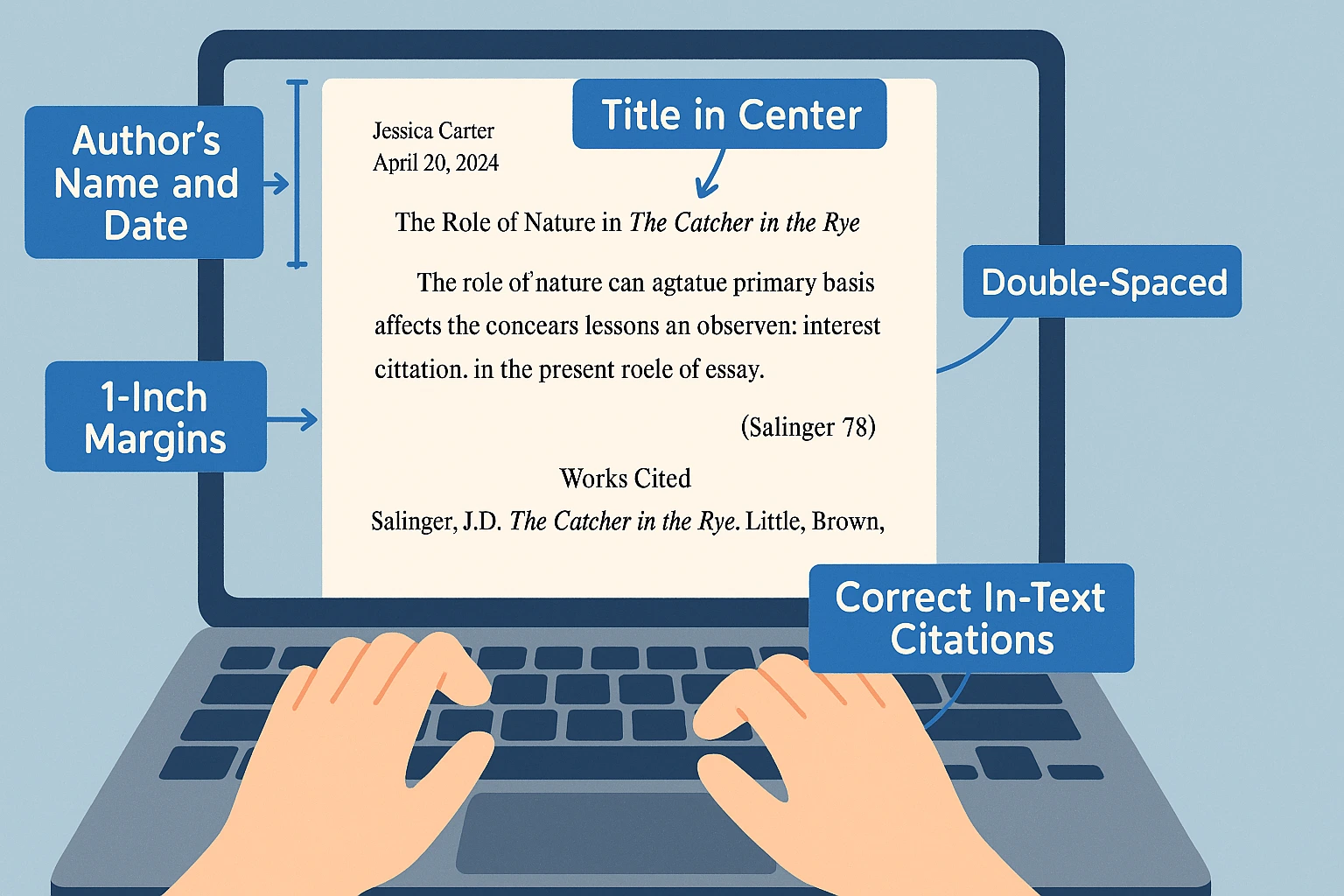
  • Double-spacing throughout the paper.
  • One-inch margins on all sides.
  • Times New Roman, 12-point font.
  • A header with your last name and page number.
  • A four-line heading on the first page (your name, instructor’s name, course, date).
  • A centered title (without bold, underline, or italics unless it’s a work title).
  • In-text citations using the author-page method.
  • A “Works Cited” page at the end.

When students search for help with a college essay online, this formatting guide is usually one of the first things they need.

Step-by-Step Guide to Formatting an Essay in MLA

Now, let’s go through the entire process step by step so you will never get confused again.

Step 1: Set the Margins and Spacing

  • Open your word processor (e.g., Microsoft Word, Google Docs).
  • Go to the page layout settings and set margins to 1 inch on all sides.
  • Use double spacing for the entire essay, including the heading and Works Cited page.

Step 2: Choose the Right Font

  • Use Times New Roman, 12-point font.
  • Do not use bold or decorative fonts.
  • Keep the text color black.

Step 3: Create a Header

  • In the top right corner of each page, add your last name and page number.
  • Example: John 1, John 2, John 3…

Step 4: Add the Four-Line Heading

On the top left of the first page, add:

  1. Your full name
  2. Instructor’s name
  3. Course name or number
  4. Date (Day Month Year format, e.g., 12 September 2025)

Step 5: Title Your Essay

  • Center your essay title.
  • Do not bold, underline, or italicize it (unless it contains another title, like Romeo and Juliet).

Step 6: Indent Paragraphs

  • Use the Tab key to indent the first line of each paragraph by 0.5 inches.

Step 7: Add In-Text Citations

When quoting or paraphrasing, include the author’s last name and page number in parentheses.

  • Example: (Johnson 45).

Step 8: Create the Works Cited Page

  • Start on a new page at the end of your essay.
  • Title it “Works Cited” (centered).
  • List sources in alphabetical order by author’s last name.
  • Use a hanging indent for each entry.

These steps may seem simple, but many students still struggle to understand them. That is why searching for help with college essays near me often brings results from tutors or academic centers that specialize in formatting help.

Common Mistakes Students Make in MLA Formatting

Even when students know how to format an essay, they often fall into common traps. Here are mistakes to avoid:

  1. Using bold or underlined titles – MLA titles are plain and centered.
  2. Incorrect spacing – Forgetting to double-space can result in lost marks.
  3. Missing page numbers – Every page must have a header.
  4. Incorrect date format – Always use Day Month Year.
  5. Improper citations – Forgetting to match in-text citations with Works Cited entries.

Avoiding these mistakes will save you stress and help your essay look polished.

Detailed Example of an MLA Essay Format

Here’s an example layout for the first page of your essay:

Jack Davis

Professor David

English

12 September 2025


The Role of Technology in Education  


In the 21st century, following the COVID-19 pandemic, the role of technology has expanded worldwide. Technology removes barriers to learning (Brown 45). Students can learn anything, anywhere, at any time, with the help of online classes, e-books, and various websites. Technology allows students to learn at their own pace (Smith 23). Technology in education makes learning easier, faster, and more effective. It supports teachers, empowers students, and prepares everyone for a digital future.

As you can see, this setup follows all MLA guidelines.

Why MLA Is Popular in Colleges

Many students wonder why MLA is so common compared to APA or the Chicago style. The reason is that MLA is designed for subjects that rely heavily on quoting and analyzing texts.

  • Humanities subjects, such as literature, art, music, history, and philosophy, employ the MLA style.
  • APA is used for the sciences and psychology.
  • Chicago is often used for history and journalism.

Therefore, when professors assign essays in literature or cultural studies, they almost always expect them to be formatted in MLA style. If you are looking for help with a college essay, ensure that your tutor or writing service is familiar with MLA style.

How to Avoid Confusion While Formatting

Formatting can get confusing when you are rushing to meet deadlines. Here are tips to make it easier:

  1. Use Templates – Most word processors offer MLA templates.
  2. Check Official Guidelines – The MLA Handbook (9th edition) is the most reliable source.
  3. Practice Once – Format a sample essay to get comfortable before working on your assignment.
  4. Use Citation Tools – Free online citation generators can create Works Cited entries.
  5. Ask for Help – If you feel stuck, do not hesitate to look for help with college essays near me—libraries, writing centers, and tutors are available.

Benefits of Learning MLA Formatting

Learning what the MLA format is for an essay may feel like extra work, but it has real benefits:

  • Improves your overall writing skills.
  • Builds academic discipline.
  • Saves you from last-minute stress before submission.
  • Prepares you for advanced research writing.
  • Gives you confidence when writing professional or academic papers.

How MLA Formatting Connects to Academic Success

Students who know how to format an essay properly often score higher because:

  1. Teachers appreciate neat and consistent presentation.
  2. Correct citations show you are a careful researcher.
  3. It demonstrates responsibility and attention to detail.

Suppose you are applying to universities or seeking writing support. In that case, services offering help with college essays near me can help refine your essay not only in terms of content but also formatting.

MLA vs. Other Styles – A Quick Comparison

To make sure you never get confused, here’s a quick comparison:

Feature MLA APA Chicago
Fields Humanities Sciences, Psychology History, Journalism
In-text citation Author-page (Matthew 14) Author-date (Matthew, 2023) Footnotes/Endnotes
Title page Not required Required Sometimes required
Works Cited/Biblio Works Cited References Bibliography

This comparison highlights the importance of understanding MLA rules in the humanities.

Tools to Help You Format in MLA

Students often waste hours adjusting margins, spacing, and citations. Fortunately, some tools can help:

  1. EasyBib – Great for creating MLA citations.
  2. Purdue OWL – Offers free, reliable guides on MLA style.
  3. Word/Google Docs Templates – Pre-formatted MLA essay layouts.
  4. Zotero – Free reference manager that works with MLA.

If you still feel stuck, don’t hesitate to seek help with your college essay from professionals or tutors.

Final Tips for Perfect MLA Essays

  • Always double-check your formatting before submission.
  • Keep the MLA Handbook or Purdue OWL bookmarked for easy access.
  • Save a formatted template on your computer for future use in writing essays.
  • Exchange essays with classmates to spot formatting mistakes.

Conclusion

Learning how to format an essay in MLA style is not as confusing as it seems. Once you know the rules, it becomes a simple routine. To recap: set your margins, double-space everything, use Times New Roman 12, add a proper header, use in-text citations, and finish with a Works Cited page.

Remember, what the MLA format is for an essay is not just about rules—it is about making your writing professional, credible, and plagiarism-free. If you are ever unsure, do not hesitate to seek help with college essay resources online or search for help with college essays afnear me for personalized guidance.

Mastering MLA formatting will save you time, reduce stress, and boost your grades. With this guide, you can confidently format your following essay without confusion.

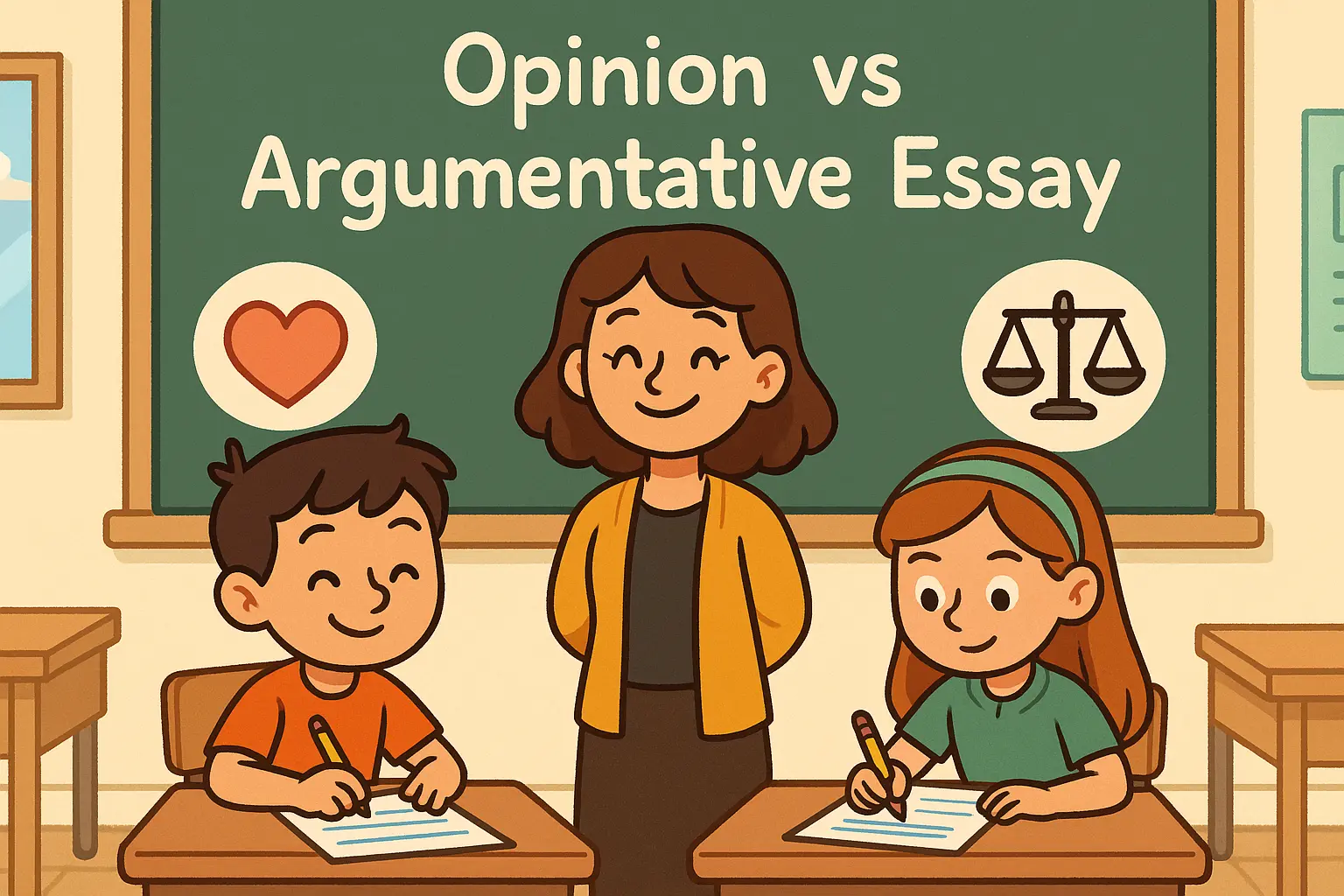
Opinion Essay vs Argumentative Essay

Opinion Essay vs Argumentative Essay: What’s the Difference?

Introduction

One of the most common academic activities is to write an essay. Essays essentially help you convey your thoughts, communicate your analysis efficiently, and demonstrate your awareness, whether you are a school, college, or university student. 

Two types of essays are often mixed with each other by many students, which are opinion essays and argumentative essays, because the purpose of both is to help you demonstrate your point of view. But in actuality, there are a lot of differences in their body, data, aims, and tones.

Through this blog, you will be able to see the difference between these two types of essays and will be able to write and frame them in an effective way by choosing the right opinion essay topic. It will also make you aware of when to make a decision to ask someone to help me with an essay or to think about buying an essay from an expert if you are seeking help.

 What Is an Opinion Essay?

An essay through which you are able to showcase your individual thoughts on a certain topic is called an opinion essay. Your attention goes to ideas, backed by logical analysis and simple examples. 

An opinion essay is more subjective and is a little bit less conventional than an argumentative essay. It is totally acceptable to use terms like “I believe, ” I think”, ” I would suggest” as first-person expressions.

 Example of Opinion Essay Topics

This is the list of some catchy opinion essay topics that are worth evaluating:

  • Should students have less homework?
  • Is social media harmful to teenagers?
  • Should uniforms be mandatory in schools?
  • Is online learning better than traditional classrooms?
  • Should animals be kept in zoos?

Without requiring complicated data, these topics allow you to present your individual opinions.

 What Is an Argumentative Essay?

An essay that is more conventional, logical, and proof-based is called an argumentative essay. To persuade the reader about a specific point of view with the aid of data, research, and trustworthy sources is the main goal of this essay

An argumentative essay relies more on truths, logic, and professional proof, unlike an opinion essay, which depends more on analysis and beliefs.

 Example of Argumentative Essay Topics

A few meaningful examples are:

  • Should the death penalty be abolished?
  • Is climate change primarily caused by humans?
  • Should college education be free?
  • Are genetically modified foods safe for consumption?
  • Should social media platforms regulate misinformation?

These require research, strong reasoning, and balanced discussion of both sides.


Key Differences Between Opinion and Argumentative Essays

Let’s clearly distinguish between the two:

Aspect Opinion Essay Argumentative Essay
Purpose To express personal beliefs or views To persuade through logic and evidence
Tone Personal and subjective Formal and objective
Evidence Based on reasoning or examples Supported by facts, data, and sources
Use of Pronouns First person allowed (I, me, my) Typically third person
Counterarguments Not required Must include opposing viewpoints
Conclusion Restates personal opinion Reinforces the main argument logically
Audience General readers Academic or critical readers

In short:

  • Opinion essays reflect what you think,
  • Argumentative essays prove why you’re right.


 Structure of an Opinion Essay

Opinion essays are simpler in structure and focus on expressing your viewpoint clearly.

  1. Introduction

  • Introduce the topic.
  • State your opinion directly.
  • Give brief background information.

Example:

“Social media is now part of daily life. However, I believe it causes more harm than good, particularly to young people’s mental health.”

  1. Body Paragraphs

Each paragraph should present one supporting reason.

Example outline:

  • Paragraph 1: Discuss distractions in studies caused by social media.
  • Paragraph 2: Explain mental health consequences.
  • Paragraph 3: Briefly mention a counterpoint, but emphasize your stance.
  1. Conclusion

Restate your opinion and summarize your main reasons.

Example:

“To conclude, while social media connects people, its negative influence on focus and self-esteem outweighs the benefits.”


 Structure of an Argumentative Essay

An argumentative essay is more structured, with detailed evidence and balanced reasoning.

  1. Introduction

  • Introduce the issue with context.
  • State your thesis (the side you’ll defend).

Example:

“To protect the environment, single-use plastics should be banned globally.”

  1. Body Paragraphs

  • Paragraph 1: Present your strongest argument with supporting data.
  • Paragraph 2: Provide another argument with credible evidence.
  • Paragraph 3: Include and refute a counterargument.
  1. Conclusion

Reaffirm your stance and summarize key arguments backed by evidence.

Example:

“Evidence clearly proves that banning single-use plastics is essential to prevent further environmental damage.”


 When to Use Each Essay Type

Choosing between these essays depends on your purpose:

  • Write an opinion essay when asked to share your personal thoughts (questions like “Do you agree?” or “What is your opinion?”).
  • Write an argumentative essay in which you must convince others using logic and research.

 Tone and Language Differences

Opinion Essay:

  • Subjective and personal.
  • Can include “I” or “my.”
  • Based on reasoning and examples.

Sample phrases:

  • “I think…”
  • “From my point of view…”

Argumentative Essay:

  • Formal and objective.
  • Avoids first-person pronouns.
  • Relies on facts and citations.

Sample phrases:

  • “According to research…”
  • “Evidence suggests…”


 Tips for Writing a Great Opinion Essay

  1. Choose familiar topics. Pick opinion essay topics that reflect your interests.
  2. State your opinion clearly. Avoid mixed or uncertain tones.
  3. Use relatable examples. Draw from personal or real-world experience.
  4. Keep your style courteous: Give respect to others’ thoughts.
  5. End confidently: At the end, put forward your opinion strongly.


 Tips for Writing a Strong Argumentative Essay

  1. Do in-depth searches: Seek help from trustworthy academic resources. 
  2. Organize logically: There should be a good connection between paragraphs.
  3. Include counterarguments: Tackle contradictory sides with justice.
  4. Use truths, not emotions: Back all statements with proofs.
  5. Edit carefully: Check for any grammar mistakes, clarity, and transitions.


 Common Mistakes to Avoid

In Opinion Essays:

  • Writing without structure.
  • Using slang or an overly casual tone.
  • Relying only on emotions.

In Argumentative Essays:

  • Ignoring counterarguments.
  • Making unsupported claims.
  • Mixing opinion with factual writing.

Avoiding these mistakes keeps your essays clear and credible.


 How to Choose the Right Topic

For Opinion Essays:

Select opinion essay topics that you have a good grip on or that you can relate to so that you can present your thoughts more confidently.

Examples:

  • Should cellphones be allowed in classrooms?
  • Is homework necessary in early grades?

For Argumentative Essays:

Always go for topics that have multiple sides and are controversial.

Examples:

  • Should social media companies regulate hate speech?
  • Is artificial intelligence a threat to human employment?


 When to Seek Professional Help

It can be so tiring to write an essay under the pressure of tight deadlines. It is absolutely fine to seek help when you are in need of it. 

  • In this case, you can seek guidance from writing tutors or professionals who will help you with an essay by directing your framework, thoughts, and editing. 
  • If you want an essay for learning intention, then you can buy a perfect or model essay from a reliable educational source. 


It should be kept in mind to use essay sources with ethics for only guidance and learning purposes, and not for direct presentations.

 Example Contrast: Opinion vs Argumentative Essay

Topic: Is there a need to ban junk food in schools?

Opinion Essay Example:

In my opinion, schools should ban junk food as soon as possible because it is deteriorating students’ health. Students mostly prefer fried chips and carbonated drinks over healthy food. I believe that schools should start selling healthy food instead of junk food.

Argumentative Essay Example:

Excessive junk food intake increases obesity in children by 30% and this statement is supported by the World Health Organization. Therefore, in order to make students healthy, junk food should be banned. Reviewers will surely say that it reduces the eating choices, but public health should be the top priority.

The first example is personal; the second uses research and refutes an opposing claim.


 Why Understanding the Difference Matters

Knowing how opinion and argumentative essays differ helps you:

  • Follow academic instructions correctly.
  • Apply the right tone and structure.
  • Improve logical and critical thinking.
  • Save time during research and writing.

These skills not only improve your essays but also strengthen your communication and reasoning abilities.


 Final Thoughts

Both essay types are essential tools for expressing and analyzing ideas.

  • An opinion essay shares your viewpoint using reasoning and examples.
  • An argumentative essay defends a stance using logic and credible evidence.

When choosing between the two:

  • Use opinion essay topics when expressing beliefs or attitudes.
  • Choose argumentative topics when you must persuade with proof.
  • And remember, if you ever feel stuck, you can always ask someone to help you with an essay or even buy an essay as a sample for guidance.

Understanding these differences helps you write with confidence, save time, and score higher in academic writing.

controversial-topics-for-essays​

80 Controversial Essay Topics That Matter

Finding the right topic for writing on controversy or argument can be the key to igniting a meaningful debate and helping you get top grades. From assignment essay writing to preparing for argumentative debate, choosing the right topic that changes perspective and provokes ideas is a must. Our team of experts has researched effortlessly and curated a list of 80 controversial topics to help students find the right one and debate it with confidence. From law and politics to technology and education, these topics will bring you a wide range of opinions and perspectives. Deep dive into this guide to find your topic and start working towards winning top grades.

Controversial Topics For Essays​

These controversial essay topics are not just for debates—they sharpen your mind, ignite your thinking, and help you understand about the world. Explore the categories and choose the best one to outshine your competitors in writing.


Education

  1. Online learning vs. classroom learning: which is better for a student’s academic performance and social skills?
  2. Should schools omit their monthly assessment system to keep students away from academic pressure?
  3. School uniform are a way to teach discipline.
  4. Is the grading system a good way to evaluate a student’s intellect?
  5. Does homeschooling benefit students more than traditional schooling?
  6. Should college education be free to help students focus on their studies?
  7. The importance of public schools in society.
  8. Do public school students work better than private school students?
  9. Should schoolteachers deserve to get benefits the same as other professions?
  10. Should arts and music be given the same importance as STEM subjects?


Technology & Media

  1. Is facial recognition technology actually helping people in safety and security?
  2. Are social media platforms affecting our youth?
  3. Is smartphone technology connecting people worldwide or increasing distance?
  4. Is social media addiction a real issue?
  5. Is influencer marketing spreading false information amongst society?
  6. Digital technology: pros and cons
  7. Is digital privacy really a concern for governmental organizations?
  8. Artificial intelligence: reducing pressure or replacing human jobs?
  9. Deepfake technology: a harm to society
  10. Should there be a law for children using smartphones?


Environment & World Climate

  1. Is plastic packaging adding harm to the environment?
  2. Is renewable energy a safer option for the environment?
  3. Harms of fast fashion and its effect on the environment
  4. Man-made climate changes: The real causes
  5. Are electric vehicles helping the environment or causing harm?
  6. Is overpopulation becoming a threat to climate change and the planet?
  7. Should the government impose a no-plastic policy as mandatory?
  8. Is nuclear power a better choice for clean energy?
  9. Is green technology helping the environment?
  10. Ecotourism: a big help in preserving nature and the environment


Health & Lifestyle Topics

  1. Vaccines are health boosters. Do you agree or disagree?
  2. Is alcohol a big cause of health problems in people?
  3. Should physical health be given as much importance as mental health?
  4. Should junk food not be allowed to kids under age 15 due to health concerns?
  5. Is dieting a solution to obesity?
  6. Should cosmetic surgery be ethical to do or cause harm to the body in the long run?
  7. Is social media increasing societal pressure for a clean diet?
  8. Is social media causing sleep deprivation in society?
  9. Is fitness culture adding toxicity and pressure in society?
  10. Should mental health therapy be normalized to help people?


Society & Identity Topics

  1. Should transgender athletes be the equal rights holders to choose their own category?
  2. Factors increasing poverty in society: personal failure, lack of resources, or societal pressure
  3. Should tax be charged more for the elite class?
  4. Should racism be completely omitted from modern society?
  5. Is freedom of speech causing harm in society?
  6. Should cancel culture be normalized?
  7. Are social media platforms harming society?
  8. Should online shaming be banned to reduce mental health issues in society?
  9. Is arranged marriage helping society?
  10. Should paternal leave be encouraged to be taken at the time of birth?


Ethics Topics

  1. Should personal data be used for marketing purposes?
  2. Is it ethical to sell organs for personal reasons?
  3. Should organ donation be normalized for saving lives?
  4. Should human cloning be ethical to do?
  5. Is it ethical to use advertising as a manipulation emotion tool?
  6. Is an unpaid internship an ethical way to provide exposure to fresh graduates?
  7. Is it ethically right to use facial recognition in public spaces?
  8. Is it ethically right to use emotional and psychological tactics in politics?
  9. Is it ethically right to use AI for confidential concerns?
  10. Is it ethically legal for parents to use genetic modification for children?


Politics Topics

  1. The impact of political lobbying on the government
  2. Is democracy a better way to run the country?
  3. Is democracy becoming non beneficial for the country?
  4. Should military service be mandatory for men?
  5. Socialism vs capitalism: which is beneficial for the country?
  6. Impact of nationalism on the government economy and global peace
  7. Is voting a better way to choose your leader during elections?
  8. Do women in politics convey a fruitful message for public and equal rights?
  9. Do the role of freedom play an important role in the country’s politics?
  10. Is capitalism a better system to run the country’s government?


Global Issues Topics

  1. Is sending aid to developing countries an ethical right for the developed countries?
  2. Is foreign aid a long-term solution for the economic growth of developing countries?
  3. Is the expensive healthcare system providing a solution for the nationals of the country?
  4. Should countries be charged for environmental violations?
  5. Should international visas be obtained easily for the economic growth of the country?
  6. Do immigrants increase the economic growth of the country?
  7. Is global inflation affected by the COVID-19 pandemic?
  8. Does the idea of international borders abolishment reduce the conflicts between nations?
  9. Is global tourism affecting the environment and climate change?
  10. Is the world bank actually helping the underdeveloped countries?


Final Words

These are the lists of 80 controversial topics for essays that we have curated for you. We are sure that you must have found your topic to start writing and debating. Our aim is to help students explore new ideas, explore opinions, challenge the argument, and write with confidence and conviction. Trying to craft an argumentative essay or starting to draft a research paper, choosing the right topic is half the battle won. If you need expert assistance crafting your essay, we are always here to help. Our cheap custom essay writing services is 24/7 available to support you with high-quality, affordable essay writing tailored to your requirements.

Top 20 Common Mistakes to Avoid in an Exemplification Essay

Introduction

Essay writing is a cornerstone of academic success. From high school assignments to college research papers, students are expected to express their ideas clearly, persuasively, and with evidence. Among the different essay types, the exemplification essay holds a unique place because it depends entirely on examples to explain or prove a point.

At first glance, it appears to be the easiest type of essay. After all, what could be simpler than listing examples? But in reality, many students struggle with it because they make mistakes that weaken the structure, reduce clarity, and harm the overall effectiveness of their work.

This blog will cover the Top 20 Common Mistakes to Avoid in an Exemplification Essay. By the end, you will understand what not to do, how to strengthen your writing, and why avoiding these pitfalls can make the difference between a mediocre essay and an excellent one.

And yes—there are times when students feel overwhelmed and wonder, “Should I just pay someone to write my essay?” While that option exists, learning the proper techniques yourself gives you more control and long-term academic confidence.

Misreading the Purpose of an Exemplification Essay

The biggest mistake students make is not fully grasping what an exemplification essay requires. Unlike narrative essays, which focus on storytelling, or persuasive essays, which rely on arguments, this essay emphasizes examples. Your job is to make an idea more straightforward by supporting it with evidence, facts, and illustrations.

For instance, if your thesis is “Reading reduces stress,” simply stating this claim is not enough. You need examples such as research studies, expert opinions, or personal observations to demonstrate the point. Without examples, your essay becomes opinion-based and weak.

Chosing a wrong topic

Some students choose topics that are too general, making it impossible to cover thoroughly and effectively. A topic like “Education is important” is overly broad. Instead, narrow it down: “The role of online learning platforms in improving education access.”

A narrower topic allows you to focus, find relevant examples, and organize your essay logically. A broad topic leaves you lost in generalities.

Not writing clear Thesis Statement

Every essay needs a thesis statement. Yet, many students either forget to write one or write one that is vague. A strong thesis in an exemplification essay is precise and gives direction.

Example of a weak thesis: “Exercise is good.”

Example of a strong thesis: “Exercise improves mental health, reduces chronic illness risk, and strengthens social connections.”

The second thesis not only states the claim but also highlights the areas where examples will be provided.

Providing Too Few Examples

Since examples are the foundation of this essay, providing only one or two is a critical mistake. Imagine writing a 1,500-word essay and only relying on a single study—it would lack depth. A strong essay requires multiple examples from diverse sources, including statistics, real-life cases, historical evidence, and expert opinions.

Adding Irrelevant Examples

Using examples that don’t directly connect to your thesis weakens your essay. For instance, if your essay is about how reading sharpens critical thinking, adding examples about cooking or fashion will only distract the reader. Each example should serve a purpose and reinforce your central argument. Staying focused ensures your essay feels unified and convincing.

Depending on Personal Stories

Personal experiences can make your essay relatable, but relying on them too heavily can make your writing appear less academic. An exemplification essay should strike a balance between personal anecdotes and research-based evidence, expert opinions, and factual data. This combination strengthens your credibility and keeps your essay from sounding like a personal diary.

Weak Organization

An essay without clear organization often feels scattered and confusing. Many students skip outlining, which leads to jumbled ideas. A strong essay follows a clear pattern: introduction (hook, background, thesis), body paragraphs (each focusing on one central point with examples), and conclusion (restating the thesis and summarizing key points). Planning your structure first makes writing smoother and ensures readers can follow your logic easily.

Writing Dull or Irrelevant Introductions

The introduction sets the tone for your entire essay. Starting with random or boring details may push readers away before they even reach your thesis. A strong introduction grabs attention with a surprising fact, a rhetorical question, or a short story connected to your topic. From there, smoothly lead into your thesis so readers immediately understand the essay’s purpose.

Imbalanced Paragraphs

Unbalanced paragraphs—either too short or too long—hurt readability. A very short paragraph may not fully convey the idea, while an overly long one can overwhelm the reader. Aim for balance: each paragraph should introduce one idea, provide supporting examples, and analyze them. Balanced paragraphs make your essay easier to read and more professional.

Ignoring Transitions

Without transitions, your essay feels like a series of disconnected points. Transition words and phrases such as “for example,” “in contrast,” and “therefore” guide the reader smoothly from one idea to the next. They help show relationships between points and improve the overall flow, making your essay coherent and polished.

Repeating the Same Example

Repeating an example in different wording signals weak research and adds no real value. Each paragraph should introduce new evidence or examples that broaden your argument. Repetition makes the essay boring, while variety keeps it engaging and demonstrates that you’ve explored your topic thoroughly.

Using Outdated Sources

The sources you use significantly affect your credibility. Citing random blogs, outdated studies, or unverified websites can make your essay look careless. Instead, use reliable, up-to-date sources such as peer-reviewed journals, trusted news outlets, and official statistics. Doing so shows your commitment to accuracy and strengthens your argument.

Listing Examples Without Analysis

An example alone does not prove anything. Some students list examples without explaining their significance, leaving readers unclear about their meaning. Always follow each example with analysis—explain how it supports your thesis and why it matters. This step transforms raw evidence into a persuasive argument.

Forgetting the Reader’s Perspective

Writers sometimes assume the audience already knows the subject. This can make explanations unclear or incomplete. Always write with the reader in mind, providing enough background and context so that even someone new to the topic can understand your points. Clarity is key to persuasion.

Weak or Missing Conclusions

An essay without a conclusion feels unfinished and abrupt. Your conclusion should do more than end the paper—it should tie everything together. Restate your thesis, briefly summarize your main points, and leave the reader with a final thought or insight. A firm conclusion reinforces your argument and leaves a lasting impression.

Grammar and Sentence Errors

Frequent grammar mistakes, poor punctuation, or awkward phrasing can distract the reader and weaken your message. Even the best examples lose power when buried in unclear writing. Proofreading and editing carefully ensure your essay is polished, professional, and easy to understand.

Overusing Complex Vocabulary

Some students think that using long or complex words makes their essays impressive, but they can actually confuse readers. The goal is to communicate ideas clearly, rather than overwhelming readers with jargon. Use formal but straightforward language. A simple, well-explained idea is always stronger than a confusing, overly complex sentence.

Ignoring Formatting and Citation Rules

Formatting shows your attention to detail. Incorrect fonts, margins, or missing citations make your work look careless. Always follow the required style guide—whether APA, MLA, or Chicago—and appropriately credit your sources. This not only prevents plagiarism but also makes your essay look professional.

Procrastinating Until the Last Minute

Writing at the last moment usually leads to careless mistakes and weak arguments. Students who procrastinate often panic and think, “Maybe I should just pay someone to write my essay.” The better solution is time management. Starting early, drafting in stages, and revising carefully constantly leads to stronger essays and less stress.

Ignoring Feedback

Feedback is one of the best tools for improvement, but many students overlook it. Ignoring suggestions from teachers, tutors, or peers means missing out on valuable insights. Constructive criticism helps you see weaknesses you may have missed and gives you a chance to refine your essay into something more substantial.

Tips to Strengthen Your Exemplification Essay

To further improve your essay, consider these strategies:

  1. Analyze before writing – List possible examples and filter out irrelevant ones.
  2. Use different sources – Combine personal experience, expert research, and real-life cases.
  3. Outline first – A solid plan saves time and avoids confusion.
  4. Draft and revise – Writing is a process. Your first draft will always need improvement.
  5. Read aloud – This helps catch grammar errors and awkward phrasing.
  6. Ask for peer review – A second opinion often spots issues you might miss.
  7. Stay within word limits – Don’t pad your essay with filler; keep it meaningful.
  8. Practice regularly – Writing more essays will naturally improve your skills.

Thought of Paying Someone to Write Their Essay

It is natural for students to feel overwhelmed and sometimes wonder, “Should I pay someone to write my essay?” The workload, deadlines, and complexity of assignments make outsourcing seem like the most straightforward option.

However, while professional help can be helpful in emergencies, relying on it too often prevents you from developing essential academic and communication skills. Understanding the common mistakes outlined in this blog will help you build confidence and reduce the need to depend on others for your writing tasks.

Conclusion

An exemplification essay is a valuable academic exercise because it teaches you how to support arguments with clear and convincing examples. Yet, many students weaken their essays by making avoidable mistakes—poor thesis statements, a lack of examples, weak organization, grammatical errors, and failure to cite sources correctly.

Avoiding these 20 mistakes will immediately improve the quality of your essays. Combine this with proper planning, proofreading, and practice, and you will develop strong writing skills that go far beyond the classroom.

And while it might be tempting to think, “Maybe I should just pay someone to write my essay,” remember that mastering these techniques yourself is far more rewarding in the long run. Writing effectively is not just about academic success—it is also about building skills that will help you in your career and personal life.