Chemistry Research Topics

Interesting Chemistry Research Topics You Can Explore (2025 Guide)

Chemistry is one of the essential and developing subject of science. It connects biology, physics, environmental science, engineering, and even medicine. Whether you are a high-school student, a university graduate, or a young researcher, chemistry offers countless areas you can explore. What makes chemistry exciting is that it explains everything around us—air, food, medicines, materials, pollution, technology, and even life itself.

In this blog, we will explore Interesting Chemistry Research Topics that are suitable for assignments, projects, theses, and presentations. We will also highlight keywords such as Chemistry Research Topics, research in chemistry topics, affordable research papers, and affordable thesis writing services to support your academic needs.

Why Choose Chemistry Research?

Before looking into the topics, it’s important to understand why chemistry is worth exploring:

Chemistry explains real-life problems

From water pollution to climate change, chemistry helps us understand and solve major challenges.

Great for academic projects

Teachers and professors love chemistry projects because they involve experiments, analysis, and logical thinking.

Opens career opportunities

Research in chemistry leads to careers in pharmaceuticals, materials science, environmental science, biotechnology, and more.

Endless topics to explore

Chemistry is so vast that you will never run out of ideas.

How to Choose the Best Chemistry Research Topic

While selecting Chemistry Research Topics, make sure of some tips including:

  • Pick something that involves your own interest.
  • Choose a topic with enough available literature.
  • Make sure it matches your subject level (school, college, or university).
  • Avoid difficult and complex topics unless you have enough time.
  • If you’re preparing long assignments or thesis, you can also get help from affordable research papers or affordable thesis writing services.

Interesting Chemistry Research Topics You Can Explore

Following is the list of best research in chemistry topics across different fields. You can easily choose the topic from here relevant to your assignment.

Basic Chemistry Topics 

  • The history of chemistry and its evolution
  • How different chemicals react with one another
  • The role of chemistry in the environment
  • The health effects of different chemicals
  • Chemical reactions in everyday life
  • The importance of the periodic table in chemistry
  • Simple chemical experiments and their real-world applications
  • Understanding the chemical properties of common household substances
  • The role of chemical processes in cooking and baking
  • Introduction to organic chemistry: What makes a compound organic?

Organic Chemistry Research Topics

  • Investigating new methods for synthesizing chiral molecules
  • Studying the role of enzymes in organic synthesis
  • Exploring new ways to control the stereochemistry of organic reactions
  • Designing benzene derivatives with improved thermal stability
  • Molecular bonding in drug design: Enhancing medicinal chemistry
  • Synthesis of bioactive molecules using green chemistry techniques
  • Mechanisms of carbon-carbon bond formation in organic reactions
  • Organic catalysts in industrial chemical processes
  • Chirality and its role in pharmaceutical chemistry
  • Developing biodegradable plastics using organic chemistry

Inorganic Chemistry Research Topics

  • How different metals react with one another in inorganic reactions
  • The role of inorganic chemistry investigation in environmental chemistry
  • The future of inorganic chemistry in pharmaceuticals
  • Rare earth elements and their applications in electronics
  • Inorganic compounds in sustainable energy storage solutions
  • Reactivity of organometallic compounds in synthetic chemistry
  • Electrocatalysis using transition metal complexes
  • Inorganic photochemistry: light absorption and emission in materials
  • Synthesis of hybrid inorganic-organic materials
  • Magnetic properties of inorganic compounds

Analytical Chemistry research topics

  • Applications of mass spectrometry in proteomics
  • Chromatographic techniques in pharmaceutical analysis
  • Spectroscopic methods for environmental pollutant detection
  • Electrochemical sensors for detecting heavy metals
  • Analytical methods in food safety testing
  • Forensic applications of analytical chemistry techniques
  • Developing biosensors for medical diagnostics
  • Quantitative analysis of pharmaceutical compounds
  • Nanoparticle detection using advanced analytical methods
  • Use of isotopic labeling in metabolic studies

Biochemistry and Molecular Biology Topics

  • The role of enzymes in drug metabolism.
  • Structural and functional analysis of ribonucleic acid (RNA).
  • Chemotherapeutic agents: Molecular mechanisms of action.
  • The role of protein-protein interactions in cell signaling.
  • Exploring the biochemical pathways of human diseases like Alzheimer’s and Parkinson’s.
  • Designing enzyme inhibitors for the treatment of cancer.
  • Metabolic profiling of cancer cells for therapeutic development.
  • Study of biomolecules in the human microbiome.
  • The impact of gene editing technologies like CRISPR in biochemistry.
  • Developing vaccines through the manipulation of protein structures.

Physical Chemistry Topics

  • Thermodynamic principles of chemical reactions.
  • The role of surface chemistry in catalysis.
  • Understanding reaction rates: Kinetic studies of chemical reactions.
  • Advances in quantum chemistry for understanding molecular behavior.
  • The relationship between molecular structure and physical properties.
  • Modeling chemical reactions using computational chemistry methods.
  • Exploring the physics of electron transfer in electrochemical cells.
  • The study of phase transitions in complex systems.
  • The impact of temperature and pressure on reaction equilibria.
  • Intermolecular forces and their influence on molecular dynamics.

Green Chemistry Topics

  • Advancements in solar energy technology.
  • Biodegradable polymers: Synthesis and applications.
  • Development of green solvents in chemical reactions.
  • Hydrogen production through environmentally friendly processes.
  • The role of renewable feedstocks in sustainable chemical production.
  • Green chemistry techniques in the synthesis of pharmaceuticals.
  • Recyclable and renewable materials for packaging.
  • The use of waste by-products in chemical manufacturing.
  • Sustainable catalytic processes for industrial applications.
  • Chemistry of sustainable food packaging.

Nanotechnology and Nanochemistry Topics

  • The role of nanomaterials in drug delivery systems.
  • Synthesis and applications of carbon nanotubes in electronics.
  • The use of nanoparticles in cancer treatment.
  • Nanoelectronics and their potential for future technology.
  • The impact of nanomaterials on the environment.
  • Nanocatalysts in green chemistry applications.
  • The properties of nanomaterials and their effect on material science.
  • Synthesis of quantum dots for imaging applications.
  • The application of nanomaterials in energy storage and conversion.
  • Investigating the toxicity and safety of nanoparticles.

Computational Chemistry Topics

  • The use of molecular dynamics simulations to study protein folding.
  • Computational chemistry approaches to drug design.
  • The role of artificial intelligence in predicting molecular properties.
  • Quantum chemical calculations for understanding chemical bonding.
  • Simulating reaction mechanisms using computational tools.
  • The use of density functional theory (DFT) in material science.
  • Advances in machine learning for molecular design.
  • The impact of computational chemistry on nanomaterials.
  • High-performance computing in chemical research.
  • Using computational chemistry to study complex molecular interactions.

Theoretical Chemistry research topics

  • Computational methods in drug discovery
  • Quantum mechanics in molecular modeling
  • Density functional theory and its applications in chemistry
  • Modeling chemical reactions at the atomic level
  • Molecular dynamics simulations of protein folding
  • Theoretical studies of reaction mechanisms
  • Quantum chemical calculations in material design
  • Predictive models for catalytic activity
  • Computational exploration of new chemical compounds
  • Theoretical approaches to enzyme catalysis

Supramolecular Chemistry research topics

  • Self-assembly of nanostructures using supramolecular chemistry
  • Molecular recognition in drug delivery systems
  • Host-guest interactions in molecular machines
  • Design of supramolecular catalysts for green chemistry
  • Supramolecular polymers: synthesis and applications
  • Role of hydrogen bonding in supramolecular architectures
  • Self-healing materials using supramolecular interactions
  • Molecular cages and their use in encapsulation
  • Supramolecular chemistry in organic electronics
  • Design of supramolecular hydrogels for biomedical applications

Polymer Chemistry research topics

  • Biodegradable polymers: synthesis and environmental impact
  • Polymers in tissue engineering and regenerative medicine
  • Conductive polymers in electronic devices
  • Development of high-performance thermoplastic polymers
  • Polymer nanocomposites: properties and applications
  • Polymer blends and alloys: improving material properties
  • Intelligent polymers for drug delivery systems
  • Self-healing polymers for advanced material applications
  • Role of polymers in food packaging materials
  • Polymerization mechanisms in free-radical polymerization

Industrial Chemistry research topics

  • Development of new catalysts for industrial chemical processes
  • Green technologies for waste reduction in chemical industries
  • Polymer chemistry in industrial applications
  • Industrial applications of bio-based chemicals
  • Chemical process intensification in manufacturing
  • Role of chemical engineering in the production of clean fuels
  • Innovations in corrosion protection for industrial equipment
  • Industrial-scale production of specialty chemicals
  • Chemical processes for carbon capture in industrial settings
  • Advances in the development of industrial adhesives

Supramolecular Chemistry research topics

  • Self-assembly of nanostructures using supramolecular chemistry
  • Molecular recognition in drug delivery systems
  • Host-guest interactions in molecular machines
  • Design of supramolecular catalysts for green chemistry
  • Supramolecular polymers: synthesis and applications
  • Role of hydrogen bonding in supramolecular architectures
  • Self-healing materials using supramolecular interactions
  • Molecular cages and their use in encapsulation
  • Supramolecular chemistry in organic electronics
  • Design of supramolecular hydrogels for biomedical applications

Research Project Ideas about The History of Chemistry

  • How did alchemy pave the way for modern chemistry?
  • What were the key discoveries in the 17th and 18th centuries that contributed to the birth of modern chemistry?
  • How did Antoine Lavoisier earn the title “Father of Modern Chemistry,” and what were his major contributions?
  • What role did Dmitri Mendeleev’s Periodic Table play in advancing the understanding of chemical elements?
  • How did the discovery of the electron challenge earlier concepts of the atom?
  • How did Marie Curie’s research on radioactivity influence the development of nuclear chemistry?
  • What was the significance of the development of the atomic model by Niels Bohr in the early 20th century?
  • How did the discovery of the structure of DNA revolutionize the field of biochemistry?

Need Help with Your Chemistry Assignments or Research?

Chemistry topics can sometimes feel overwhelming, especially if you are dealing with multiple deadlines. Many students use affordable research papers and affordable thesis writing services to save time and reduce stress. These services help you:

  • Choose a strong research topic
  • Prepare outlines and literature reviews
  • Write high-quality assignments
  • Edit your research paper
  • Format according to APA, MLA, or Chicago style

Final Thoughts

Chemistry is a huge, exciting, and Fastly growing field of science with endless opportunities for learning and discovery. Whether you want simple project ideas or advanced research problems, the Chemistry Research Topics provided in this blog will help you find the perfect area to explore. Topics related to organic or inorganic chemistry, biochemistry or physical chemistry, environmental chemistry or medicine drugs, and many more are included in this. 

So, you can use these topics for writing a strong research paper, presentations, and lab report etc. And if you find difficulty in writing, you can always rely on affordable research papers and affordable thesis writing services to support your academic journey.

How to Write a Thesis?

How to Write a Thesis Step by Step: A Complete Student Guide

Writing a thesis is one of the biggest academic challenges students face, and for many, it can feel like a stressful and overwhelming journey. Whether you are completing an undergraduate, graduate, or postgraduate degree, your thesis is a reflection of your research abilities, academic knowledge, and critical thinking skills. If you have ever wondered How to Write a thesis, this complete guide will walk you through the process in a simple and understandable way. Every step has been explained in clear language so you can follow it without confusion. And if you ever feel stuck or short on time, students often turn to write my thesis services or responsible affordable assignment help options for guidance, editing, or research support.


Understanding What a Thesis Really Is 

Before diving into the writing process, it is important to understand the purpose of a thesis. A thesis is a long academic document that presents a student’s original research on a particular topic. It includes a central research question, a review of what other scholars have written on the subject, a detailed explanation of your research method, the results you found, and the meaning behind those results. In short, your thesis is evidence of your ability to think scientifically and contribute something new or valuable to your academic field.


Choosing a Relevant and Manageable Topic

The first major step in How to Write a thesis is selecting a topic. Your entire thesis will revolve around this one decision, so choosing wisely is important. A good thesis topic should interest you and be directly related to your field of study. It should also be specific enough to allow focused research. Instead of selecting a broad topic like “Business Growth,” a more manageable one could be “The Impact of Social Media Marketing on Small Businesses in Pakistan.” The more specific your topic, the easier it is to research and write a strong thesis.

Some students find this step difficult because they are unsure whether their topic is too broad, too narrow, or academically suitable. In such cases, many turn to affordable assignment help services to refine their ideas or receive feedback from academic experts.


Formulating Your Research Question

Once your topic is finalized, the next essential step is defining your research problem or question. This question guides your entire thesis. A good research question should be specific, clear, and answerable within the timeframe and resources you have. For example, instead of asking “How does technology affect education?” you can ask “How do mobile learning applications influence academic performance among university students in Lahore?” A well-defined research question ensures your thesis stays focused and organized.


Reading Background Literature

Before writing anything, you need a strong understanding of existing research. This is the stage where you begin reading previous studies, academic journals, articles, and books related to your topic. This step helps you understand what other researchers have already discovered and what gaps still exist in the literature. While reading, take notes on key theories, arguments, and findings, as they will later form the foundation of your literature review chapter.

Reading background literature is time-consuming, but it gives you clarity about your topic and helps you justify why your research is important. This knowledge will also guide you when choosing your methodology and designing your study.


Preparing Your Thesis Proposal

Most universities require students to submit a thesis proposal before they begin writing the actual thesis. This proposal outlines your research question, the purpose of your study, a brief summary of the literature, your chosen methodology, and what you expect to achieve through your research. The proposal allows your supervisor to evaluate whether your topic is relevant, manageable, and academically sound.

If you struggle with structuring your proposal, students often reach out to write my thesis guidance or editing support to make sure their proposal is clear and complete.


Creating a Research Plan

A thesis is a long project, so planning your timeline is very important. Create a schedule that outlines when you will finish your literature review, when you will collect data, and when you will write each chapter. Planning your research in smaller sections makes the entire process more manageable. Many students underestimate the time needed for data collection or revisions, so it is helpful to set realistic deadlines and follow them consistently.


Writing the Literature Review

After gathering enough background material, you can begin writing your literature review. Instead of summarizing every article, your goal should be to analyze and connect different studies. Explain how previous scholars have approached your topic, what results they found, what theories they used, and what gaps or unanswered questions still remain. Your literature review proves that you understand the academic conversation around your topic and that your research fits into this conversation.


Designing Your Methodology

The methodology is one of the most important chapters of your thesis. It explains how you conducted your research and why you selected those methods. In this chapter, you describe whether your research follows a qualitative, quantitative, or mixed-method approach. You also explain how you collected your data whether through surveys, interviews, experiments, or document analysis. Furthermore, you describe how you selected your participants and how you analyzed your results. A clear methodology section allows other researchers to understand your approach and even replicate your study.


Collect Your Data

This is the stage where you gather information using the method you selected. Make sure your data is:

  • Ethical
  • Accurate
  • Well-documented
  • Organized

If you conduct interviews or surveys, store the responses carefully. Data collection may take weeks or months depending on your topic.


Analyze the Data

After collecting data, you must interpret it. For quantitative data, this may include:

  • Statistical tests
  • Graphs and charts
  • Regression analysis

For qualitative data, this may include:

  • Themes
  • Patterns
  • Narratives

Data analysis is often the most challenging stage of thesis writing. When students feel stuck, they sometimes seek affordable assignment help to check their analysis or guide them on the right approach.


Write Your Thesis Chapter by Chapter

Now you are ready to begin writing. Most theses follow a standard structure:


Chapter 1: Introduction

The introduction includes:

  • Background of the study
  • Research problem
  • Objectives
  • Research questions
  • Scope and limitations
  • Significance

This chapter explains what your research is about and why it matters.


Chapter 2: Literature Review

This chapter reviews previous studies and shows how your research fits into the existing body of knowledge.


Chapter 3: Methodology

Explain your research design, data collection methods, and analysis techniques. Make sure it is detailed enough for another researcher to replicate.


Chapter 4: Results or Findings

Present your data clearly. Use:

  • Tables
  • Charts
  • Graphs
  • Descriptions

Do not interpret here. Only report your results.


Chapter 5: Discussion

Discuss what your results mean. Explain whether your research question was answered. Compare your findings with previous studies from the literature review.


Chapter 6: Conclusion

Summarize your research. Include:

  • Main findings
  • Implications
  • Limitations
  • Recommendations for future studies

This chapter is your final message to readers.


Editing and Proofreading Your Thesis

Editing is an essential part of thesis writing. Once your chapters are complete, read them carefully to identify grammar mistakes, unclear sentences, and weak arguments. You may need to reorganize paragraphs, add missing information, or improve the flow of your writing. Proofreading helps ensure your thesis is polished and professional. Many students use write my thesis services for proofreading or editing support to ensure their document is error-free and academically strong.


Formatting According to University Guidelines

Every university follows a specific formatting style such as APA, MLA, Chicago, Harvard, or IEEE. Your thesis must follow the required style exactly, including the structure of headings, citations, references, and page layout. Proper formatting enhances the academic quality of your thesis and prevents penalties for technical mistakes.


Creating the Reference List

A complete reference list is a necessary part of any thesis. It includes every source you cited in your work. Maintaining accurate references shows academic honesty and prevents plagiarism. Using citation tools can help you keep your sources organized throughout the writing process.


Getting Feedback from Your Supervisor

Once your thesis is written and formatted, share the draft with your supervisor for feedback. Supervisors help point out weaknesses, unclear arguments, missing data, or areas that require improvement. It is completely normal to revise your thesis multiple times. Revisions make your work stronger and increase your chances of achieving a higher grade.


Preparing for the Thesis Defense

If your university requires a thesis defense, you will need to prepare a presentation summarizing your research question, methodology, findings, and conclusions. Practicing your presentation helps build confidence and ensures you can answer the committee’s questions effectively.


Submitting Your Final Thesis

After completing all revisions, formatting, editing, and preparing your defense, the final step is to submit your thesis. Make sure to review the submission guidelines carefully and meet all deadlines.


Helpful Tips for a Successful Thesis

To better understand How to Write a thesis, it is useful to keep a few practical tips in mind. Start your work early to avoid unnecessary pressure. Stay organized by keeping your notes, sources, and drafts arranged neatly. Write consistently instead of waiting for inspiration. Always cite your sources to avoid plagiarism. And most importantly, do not hesitate to ask for help when you need it. Many students rely on affordable assignment help or academic consultation services to guide them through complex stages like data analysis or literature review writing.


Why Students Seek Professional Academic Support

Thesis writing is a demanding process that requires significant time, patience, and academic skill. Many students struggle because they have part-time jobs, family responsibilities, or other coursework. Others feel insecure about their writing or find it difficult to analyze complex data. Some students simply do not understand how to structure their thesis properly. For these reasons, students often seek responsible academic support through write my thesis services, which provide assistance with editing, structuring, proofreading, research guidance, and organization. These services do not replace the student’s work but help them complete it more effectively.


Conclusion

Understanding How to Write a thesis becomes much easier when you break the entire process into smaller steps. From choosing a topic to conducting research, analyzing data, and preparing for the defense, each stage requires focus and commitment. Although the process is long, it is also highly rewarding because it allows you to contribute original knowledge to your field of study. And if the journey becomes challenging, you can always seek responsible academic guidance through affordable assignment help or write my thesis services to stay on the right track.

Dissertation vs Thesis

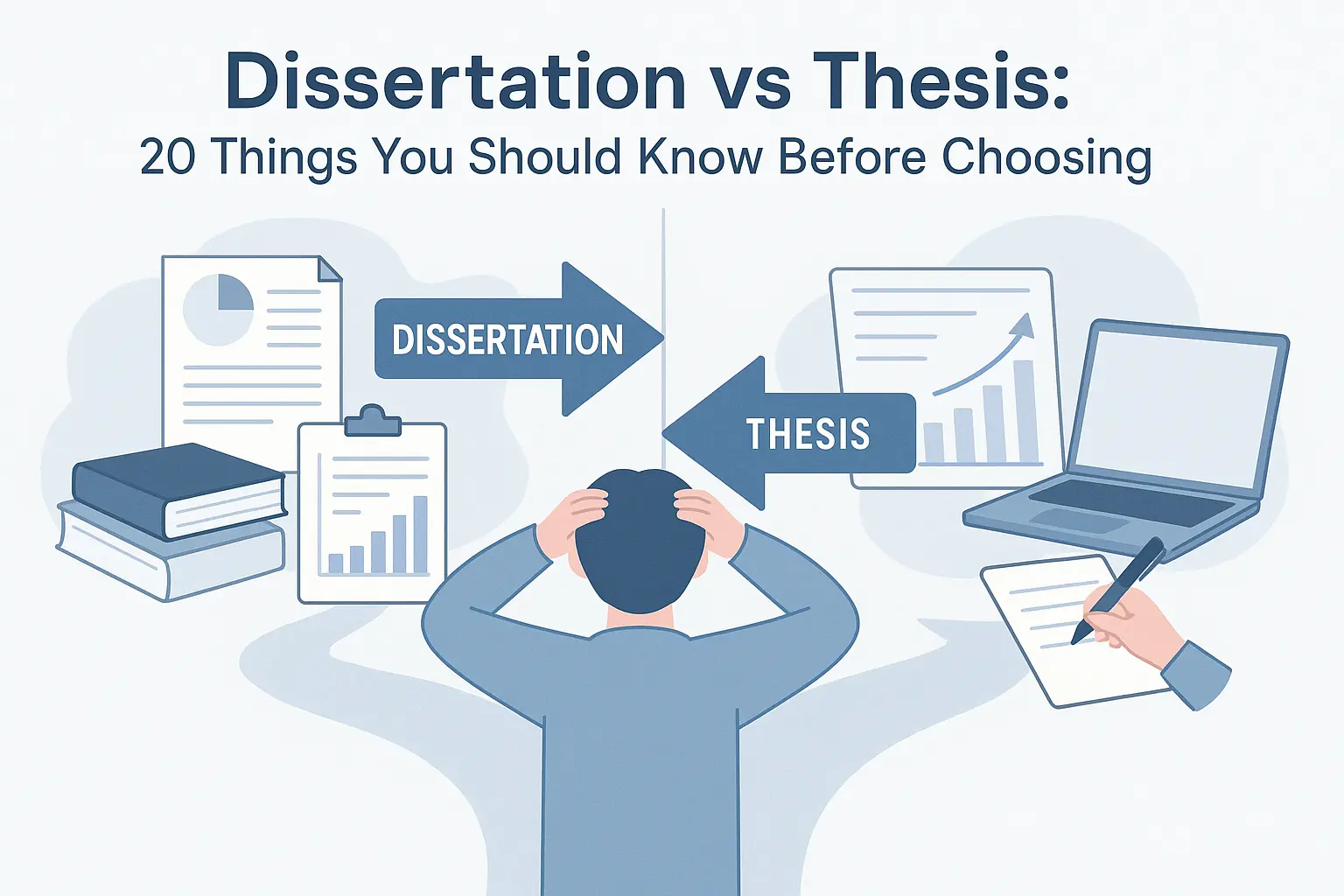
Dissertation vs Thesis: 20 Things You Should Know Before Choosing

Dissertation and thesis are two interchangeable terms, but they still hold a difference in their meaning. Before starting postgraduate studies, students often encounter these types of words, but they are unsure of the difference between a dissertation and a thesis. So, if you are trying to start higher education and don’t know the difference among them, then you are in the right spot. 

In this blog, we will help you educate yourself about everything you need to know. We will discuss 20 Things You Should Know Before Choosing between a dissertation and a thesis.

Basic Definition

 A thesis is a lengthy research paper written as a requirement to earn a master’s degree (or sometimes a bachelor’s degree). Also referred to as a “senior thesis” for undergraduate courses, these papers are written at the end of a program as a culmination of their studies, similar to dissertations.

A dissertation is a highly involved research paper written as a requirement to earn a doctoral degree. It’s more complex and demands new insights, theories, or methods.

Academic Level

One significant difference between a dissertation and a thesis lies in the academic level.

  • Thesis = Master’s degree requirement
  • Dissertation = Doctoral degree requirement

In some countries, these meanings are reversed; however, this distinction is generally the most widely accepted.

Purpose

The purpose of a thesis is to demonstrate mastery of existing research and theories. You summarize, analyze, and interpret existing work.

The purpose of a dissertation is to create new knowledge. You must identify a research gap, conduct independent research, and propose new conclusions or models.

Originality

A thesis may involve some original ideas, but it primarily focuses on interpreting and understanding existing studies.

A dissertation must be entirely original. The goal is to add something new to your academic discipline — something that has never been done before.

Length and Depth

Generally, a dissertation is longer and more detailed than a thesis.

  • Thesis: Around 15,000–20,000 words
  • Dissertation: Often 50,000–100,000 words

Because a dissertation involves new research, it naturally requires a more detailed and comprehensive explanation.

Research Type

A thesis typically involves secondary research, which entails analyzing data from existing sources, such as books, journals, and reports.

A dissertation includes primary research, such as conducting experiments, surveys, or interviews to collect new data.

Supervision and Guidance

Both require supervision from academic advisors. However, a thesis often involves closer guidance, since it’s your first major research project.

In a dissertation, the student is expected to be more independent, taking charge of research design, data collection, and analysis.

Time Required

A thesis may take one to two semesters to complete, depending on your program.

A dissertation can take several years, especially if it involves extensive research, data collection, and revisions.

Structure

While both follow a similar academic format, there are differences in structure:

  • Thesis: Focuses on summarizing existing knowledge.
  • Dissertation: Emphasizes methodology, data, and findings.

Typical chapters include introduction, literature review, methodology, results, discussion, and conclusion.

Evaluation Process

A thesis is usually graded by a panel of professors based on your understanding and interpretation of existing research.

A dissertation is defended orally in front of an academic committee, where you must justify your research approach, data, and conclusions.

Required Skills

Writing a thesis tests your ability to analyze and synthesize information.

Writing a dissertation tests your ability to design and conduct original research, along with strong analytical and problem-solving skills.

If you ever feel overwhelmed during this process, you can seek professional help from academic writing experts who can assist when you think, “I wish someone could write my thesis.”

Contribution to Knowledge

A thesis strengthens your understanding of existing research.

A dissertation makes a real contribution to your academic field by developing new ideas, methods, or discoveries.

Regional Differences

In the United States, the thesis is typically for master’s students, and the dissertation is reserved for doctoral candidates.

In the United Kingdom and Europe, the terms are often reversed: a doctoral project is referred to as a thesis, while a master’s project is called a dissertation. Always confirm the definition used by your institution.

Data Analysis

For a thesis, you analyze data collected by other researchers.

For a dissertation, you conduct your own analysis using fresh data. This means you need to learn advanced research tools and statistical methods.

Literature Review Importance

Both include a literature review, but their purposes differ.

  • A thesis summarizes key findings from existing studies.
  • A dissertation identifies research gaps that your study aims to fill.

Writing Challenges

Writing a thesis can be challenging because it’s often a student’s first large-scale academic writing project.

Writing a dissertation is even more demanding — it requires deep focus, strong organization, and sustained dedication over a long period. Many students seek expert assistance during this phase and search online for phrases such as “write my thesis” or “help with dissertation writing” to stay on track.

Review and Editing

Both documents go through multiple revisions. Supervisors review drafts, provide feedback, and ensure your work meets academic standards.

In a dissertation, there is often a formal review process by external examiners before final approval.

Job and Career Relevance

A thesis demonstrates your ability to understand and apply theories — valuable for careers in teaching, research, and professional fields.

A dissertation, however, positions you as an expert in a specific area and is often required for academic or research-based careers.

Publication Opportunities

Some thesis papers can be published in academic journals, mainly if they include a strong analysis.

A dissertation often leads to multiple publications, as it contains original research and data that can be used for several journal articles or even a book.

Final Goal

The thesis helps you earn your master’s degree and demonstrate your understanding of your field.

The dissertation helps you earn a Ph.D. and contribute to the academic community by presenting new insights or theories.

Tips for Success

Here are a few tips that will help you in finalizing:

  1. Get an early start.
  2. Choose a topic of your own interest.
  3. Get your act together.
  4. Discuss with your supervisor regularly.
  5. Don’t hesitate if you need help. You can ask someone to write my thesis or guide me through this.

Conclusion

The facts about dissertations versus theses are real. Therefore, using one term instead of another is not acceptable for an academic. One must remember the purpose of each and use them accordingly. However, one is not undermined by the other. Whether you are writing a thesis or a dissertation, both must be done with the same seriousness. Both require critical technical and soft skills. Improving your time management and academic writing skills plays a significant role in excelling in both forms of scholarly writing.

How do you decipher a dissertation vs. a thesis? Should the interchange of these terms be acceptable? How is your approach to writing a thesis different from that of a dissertation? What are the other differences associated with the thesis and dissertation? Let us know in the comments section below!

writing a dissertation

What Not to Do While Writing a Dissertation

Your thesis or writing a dissertation serves to be one of the significant central elements of your last degree. On the off chance that you effectively prevail in the foundation of your thesis or writing a dissertation, that too with quality, at that point there is nothing that can interfere with you and your graduation function. In any case, if using any means, you are unfit to finish your thesis on schedule, at that point you are in a wrong position. Students and scholarly researchers frequently commit various errors while writing their thesis, which makes it hard for them to create a dissertation of quality.

Taking References from the unknown source for writing dissertation:

One of the real slip-ups done by students while writing a dissertation or their thesis is that they take reference from some other source they run over. This isn’t what experts who give experienced direction in dissertation writing the UK do. Experts are acclimated with getting material for their writing a dissertation from first-rate diaries and other trustworthy sources, this makes your work genuine, and the aftereffects of your information will turn out right. Students regularly alarm during their viva because their educator brings up a wrong snippet of information that they set up taking reference from a source that had no legitimacy. The web is a significant space and various regular individuals set up a monstrous heap of information.

Beginning too early or too late:

This tip is connected to the first in this rundown, or, in other words, that starting the writing a dissertation too soon will, in general, imply that you have too little even to consider writing about. Research thoroughly and, maybe similarly as significant, perceive the estimation of a long, moderate brooding of musings in finding new expository bits of knowledge.

In the event that you start writing your thesis when the due date is a couple of days ahead then be rest guaranteed that you will finish up freezing and stalling and won’t most likely submit in time. It is an ill-conceived notion to start your thesis late in light of the fact that it is a long and thorough procedure that needs a predefined measure of time and should be given appropriately so to maintain a strategic distance from any glitches in its practical fruition on schedule — writing a dissertation request time on the grounds that there are various things to be finished. Also, the most time making stride is the information accumulation strategy. Henceforth it is best if matters are dealt with, directly from the earliest starting point.

Not including irrelevant info while writing a dissertation:

Ensure that your thesis has a tremendous and inside and out knowledge to the issue that is being examined in your thesis and the interim keep the significance level to 100% and abstain from putting information that is excessively remotely identified with the topic your work is based on. Keep it near the closeness of your topic and abstain from leaving the circle.

Do not plagiarize:

avoid plagiarism while writing a dissertation

Colleges currently use the advanced enemy of written falsification programming as is usually done. Obviously, you ought to never intentionally pass another person’s work off as your own; however, recollect likewise that honest mistakes in referencing and attribution of thoughts adds up to something very similar.

Now affordablewriting.net also offers Online Class Help and Online Home Work Help because our clients need it.

Also find our informative blogs on Blogspot.com

Thesis Writing

Understanding the Fundamentals of Thesis Writing

So, you’re approaching the end of the semester, and the supervisor has already arrived with a new nightmarish assignment for you. Yes, you got that right – it’s the THESIS WRITING!

A thesis is synonymous with stress, hard work, sleepless nights and all the negative adjectives you could think of. However, with a little planning and by understanding what exactly makes for a good thesis, you can sail through the process seamlessly. You might have already googled ‘how to write a thesis,’ ‘thesis writing tips’ and other search terms like these. Here, we’re making it a little more understandable for you. Read on for an insight into the fundamentals of thesis writing.

Fundamentals of Thesis Writing

Planning

Planning for Thesis Writing

All good things start with a plan, and the same holds true for a thesis assignment. You can’t just turn on your laptop and start working on it with the first idea that pops up in your mind. This is going to be a long project and therefore, you need to do a bit of planning on your part, as in, how you aim to go about.

Also, you can only make a comprehensive plan if you start early. So, brush off your procrastination, and start planning as early as you can. A plan of work will also help keep your academic, personal, and social life in balance.

Topic Selection for thesis writing

The importance of topic selection cannot be emphasized enough. The topic of your paper is the very thing that decides whether the entire process is going to be an exciting journey or a long and arduous discourse. Choosing a topic of your interest will keep you motivated and engaged throughout the process, and you’ll be surprised how convenient and smooth the whole process turns out for you.

Thesis Statement and Proposal

A thesis statement provides the basis of the argument you aim to present in your thesis. It is the central idea or a one-line summary of your thesis and defines its purpose. Likewise, a proposal is not essentially a part of the thesis; rather, an account of the purpose, objectives, and the scope of your thesis. It is a smart approach to seek your supervisor’s opinion on the statement and proposal to ensure that you’re heading in the right direction.

Style Guide

The style guide is one of the key instructions given by your supervisor, and it is absolutely necessary to stick to its specifications. There are various style guides for academic; the most commonly used ones include APA and MLA. If you’re unsure about the style guide or need help with it, reach out to your supervisor and seek their help.

Research and Evidence For Thesis Writing

Research and Evidence

You can’t make your own claims or arguments in a thesis or research paper without any evidence. Research is the most fundamental requirement of a thesis, in fact, all academic assignments. This means that whatever information you choose to include, or the arguments you put forth in your thesis should be backed by credible and authoritative evidence. Without evidence, your arguments will be considered as baseless claims.


A thesis project is inevitable in a student’s academic journey, but it doesn’t have to come as an added stress and burden to your life. Just stick to these fundamentals, and you should be good to go.

Now affordablewriting.net also offers Online Class Help and Online Home Work Help because our clients need it.

Also find our informative blogs on Blogspot.com